Quick answer: To find crypto presale investors in 2027, combine several sources instead of relying on VCs alone: angel investors and syndicates for the first checks, crypto VCs that back your stage and sector, ecosystem funds and grants, a KOL round with clear vesting, launchpads and on-chain sale platforms, and a community presale. Funding is concentrated: in Q3 2026, crypto VCs invested $4.52 billion across 296 deals, and pre-seed and seed rounds made up 45% of deals but only about 6% of the money. Investors now check traction, tokenomics, unlocks, team, and community before valuation — so prepare data, build a target list of active investors, and use warm introductions and short, specific outreach.
Raising money for a token is harder in a falling market. Investors write fewer checks, take longer to decide, and ask for proof that used to wait until after the launch. Yet projects still close presales every month — usually the ones that know where their investors are and arrive with numbers, not just a deck.
This guide explains how to find crypto presale investors in 2027: where the money is, which investor types fit which stage, what they check, how to reach them, and how to avoid the scams that target founders during fundraising. For the marketing side of a sale, see our ICO and presale marketing page.
The Crypto Fundraising Market Going Into 2027»
| Indicator | Figure |
|---|---|
| Crypto VC investment, Q3 2026 | $4.52 billion across 296 deals — capital down 20% and deal count down 24% from Q2 |
| Early-stage share, Q3 2026 | Pre-seed and seed: 44.9% of deals, about 6% of capital |
| Largest sector, Q3 2026 | Trading, exchange, investing, and lending: about $2.37 billion |
| Full year 2025 | About $18.9 billion invested, but deal count fell about 60% to roughly 1,200 |
Sources: TokenPost, The Block.
The message for founders: there’s still money, but fewer, larger checks go to projects with traction. VCs interviewed by The Block said they focus on traction and fundamentals rather than narratives, favour businesses earning fees and volume, and are sceptical of crypto-AI hype and undifferentiated new layer 1s. Early-stage projects need to widen the search beyond funds.
Where to Find Crypto Presale Investors: 6 Sources
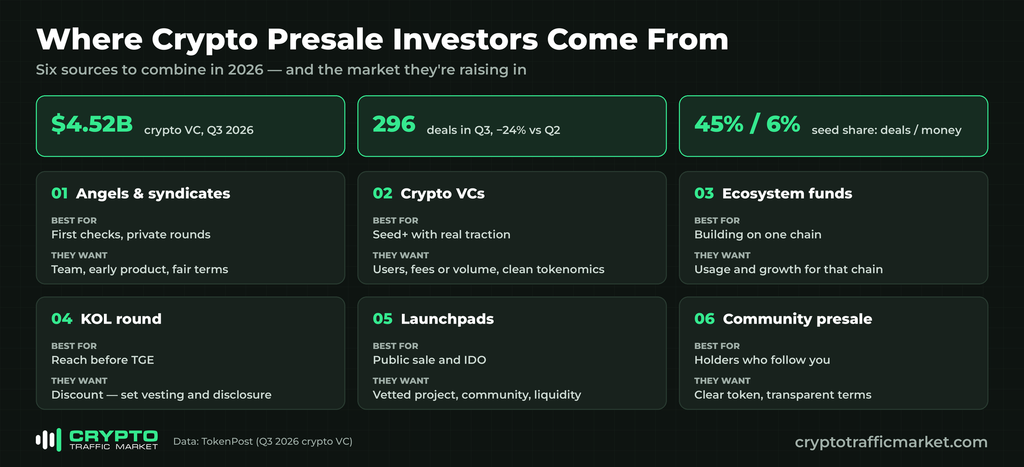
| Source | Best for | What they want | How to reach them |
|---|---|---|---|
| Angel investors and syndicates | First checks, pre-seed, private rounds | A strong team, an early product, fair terms | Warm intros, founder networks, angel groups, crypto events |
| Crypto VCs | Seed and later rounds with real traction | Users, revenue or volume, a defensible market, clean tokenomics | Warm intros; target list from recent deals on CryptoRank or DefiLlama Raises |
| Ecosystem funds and grants | Projects building on a specific chain | Usage and growth for that ecosystem | Chain foundations, grant programs, accelerators |
| KOL round | Distribution and attention before TGE | A discount, unlocks, a project they can talk about | KOL networks and agencies; direct outreach |
| Launchpads and on-chain sale platforms | Public sale and IDO | A vetted project with community and liquidity plans | Launchpad applications; see best crypto launchpads |
| Community presale | Retail buyers who already follow you | A clear token, transparent terms, trust | Your website, X, Telegram, and presale marketing |
Angel investors and syndicates
Angels are often the fastest first money for a presale: they decide personally, invest smaller amounts, and bring their own networks. Crypto founders who exited, early employees of large protocols, and operators in your niche are the best targets. Our angel investor outreach service builds and contacts this list for projects preparing a private round.
Crypto VCs
Pitch only funds that invested at your stage and in your sector in the last 6–12 months. A fund that hasn’t made a seed deal this year won’t make yours. Check each fund’s recent rounds on CryptoRank or DefiLlama, note the partner who led them, and look for a mutual connection. VCs increasingly use hybrid structures — a SAFE with a token warrant, or a SAFT — so know which instrument you’re offering before the first call. Our crypto fundraising service runs targeted fund outreach with a prepared data room.
Ecosystem funds and grants
Layer 1 and layer 2 foundations fund projects that bring users to their chain. Grants are non-dilutive but slow, and they usually come with milestones. Ecosystem backing also helps later with launchpads and listings on that chain.
KOL rounds
A KOL round sells a small allocation to influencers at a discount in exchange for coverage. CoinDesk reported that a large share of notable TGEs ran KOL rounds and that KOLs often refuse vesting longer than 12 months. The risk: KOLs who sell at TGE turn your community into exit liquidity. Set vesting, require disclosure of the investment in posts, and vet audiences for real engagement — see how to choose crypto KOLs.
Launchpads and on-chain sale platforms
Launchpads bring a ready audience of buyers and usually vet projects first. Platforms such as Binance Wallet TGEs and Coinbase’s token sale platform (built after its $375 million acquisition of Echo) have made on-chain capital formation mainstream, but they select strictly. See Binance Alpha and Wallet TGE and ICO vs IDO vs IEO for how each format works.
Community presale
Selling directly to your community gives the widest distribution, but it depends on how many people already trust you. It’s also where regulation matters most — check where you can sell before you market. See token sale regulations in 2026.
What Investors Check Before They Commit
| Area | What to prepare |
|---|---|
| Product and traction | A working product or testnet, active users, transactions, revenue or fees — with a live dashboard if possible |
| Token need | Why the product needs a token and how value accrues to it |
| Tokenomics and unlocks | Supply, allocations, vesting, and an unlock schedule that doesn’t flood the market |
| Valuation | A valuation or FDV that matches your traction — inflated FDVs are the first objection in 2026 |
| Team | Public, relevant experience; advisers who actually work on the project |
| Community | Real engagement on X and Telegram, not bought followers |
| Use of funds | A specific plan: development, audit, liquidity, market making, marketing |
| Legal structure | Entity, token sale terms, restricted countries, KYC |
Community metrics are part of due diligence: investors look at your X account and Telegram before the second call. That’s where marketing and fundraising meet — a project with an active, growing community gets more replies to the same pitch.
How to Find Presale Investors: 8 Steps
1. Decide the round and the instrument
Private round, KOL round, launchpad sale, or community presale — and SAFE, SAFT, or token warrant. Each investor type expects different terms.
2. Prepare a short data room
Deck (10–12 slides), tokenomics with vesting, product demo, metrics dashboard, team bios, and legal summary. Keep it in one shareable folder.
3. Build a target list of active investors
Use recent rounds on CryptoRank and DefiLlama to find funds and angels who invested at your stage and in your sector in the last year. Aim for 50–100 relevant names, not 1,000 random ones.
4. Find warm introductions
Founders they backed, shared investors, ecosystem teams, and advisers. A warm intro gets read; a cold message often doesn’t.
5. Send short, specific outreach
Where there’s no intro, write briefly: what you build, one traction number, the round, and why this investor fits. See the template below.
6. Grow the community while you raise
Investors watch momentum. Steady growth on X and Telegram, a waitlist, and media coverage during the raise make follow-up conversations easier. See token launch marketing.
7. Send monthly updates
Investors who said “too early” often invest after two or three updates showing progress. Keep everyone you met on a short monthly update.
8. Close with clear terms and compliance
Written agreements, KYC, restricted countries, vesting, and how tokens will be delivered. Clear terms prevent disputes at TGE.
Investor Outreach Template
Subject: [Project] — [one-line description], raising private round

Hello [Name],

I'm [Name], founder of [Project], [what it does in one sentence].

Since [launch/testnet], we've reached [one traction number: users, volume, revenue]. We're raising [amount] in a private round ahead of our token launch in [month], and [co-investors, if any] are already committed.

I'm reaching out because you backed [similar company or sector], and we think [Project] fits that thesis.

Deck and data room: [link]
Happy to share more on a 20-minute call.

[Name]
[Telegram] · [Website]
Red Flags When Raising for a Presale
- Upfront “investor introduction” fees. Paying for access to a list of investors rarely produces a round. Agree on clear deliverables and reporting before paying for any outreach service.
- Guaranteed funding. No one can guarantee that investors will invest.
- Fake funds. Check that a fund has a public portfolio, real partners, and recent deals before sharing your data room.
- Instant-unlock demands. KOLs or funds that insist on fully unlocked tokens at TGE will often sell on day one.
- Inflated valuation. A high FDV may close the round but makes the token hard to hold after launch.
How CryptoTrafficMarket Helps Projects Raise
We run investor and fund outreach and angel investor outreach for token projects, together with the marketing investors look at during due diligence: X and Telegram growth, crypto PR, and KOL campaigns. The same approach works for presales, IDO launches, and meme coin promotion — see meme coin marketing.
Crypto Marketing Packages by Project Stage
| Package | Duration | Price | Best for |
|---|---|---|---|
| Trial | 3 days | $175 + $100 in tokens | Pre-sale preparation, ICO/IDO, testing market response |
| Quick Start | 15 days | $1,250 + $600 in tokens | Pre-sale, IDO/IEO, DEX launch |
| Standard | 30 days | $3,500 + $1,500 in tokens | Token launch, DEX launch, first CEX listing |
| Growth | 45 days | $7,500 + $3,500 in tokens | Private or strategic round, post-launch growth, new exchange listings |
| Pro | 60 days | $12,500 + $8,000 in tokens | Major exchange listings, brand authority, long-term growth |
Preparing a presale or private round? Tell us your stage and target raise, and we’ll suggest an investor outreach and marketing plan. For budgets, see token launch marketing cost.
FAQ
How do you find investors for a crypto presale?
Combine several sources: angel investors and syndicates, crypto VCs active at your stage, ecosystem funds and grants, a KOL round, launchpads, and a community presale. Build a target list from recent rounds on CryptoRank or DefiLlama, use warm introductions, and send short outreach with one clear traction number.
Is it harder to raise crypto funding now?
Yes, for early-stage projects. In Q3 2026, crypto VCs invested $4.52 billion across 296 deals, down 20% in capital and 24% in deals from Q2, and pre-seed and seed rounds received only about 6% of the money despite making up 45% of deals.
What do crypto investors look for in a presale?
A working product with traction, a clear reason for the token, tokenomics with sensible vesting and unlocks, a valuation that matches traction, a public team, a real community, a specific use of funds, and a clean legal structure.
What is a KOL round?
A private allocation sold to crypto influencers, usually at a discount, in exchange for coverage of the project. It adds reach before TGE, but KOLs who sell immediately can hurt the price, so set vesting and require them to disclose their investment.
Where can I find a list of active crypto VCs?
Recent funding rounds on CryptoRank and DefiLlama Raises show which funds invested, in which sectors, and at which stage. Filter by the last 6–12 months and your sector to build a target list.
Should I raise from VCs or from the community?
Many projects do both. VCs bring larger checks and credibility; a community presale brings wide distribution and early holders. Investors told The Block the future is “hybrid,” with strong projects pairing token sales with VC backing.
Can a marketing agency help find investors?
Yes, through targeted investor and fund outreach and by building the community and media presence investors check during due diligence. No agency can guarantee that investors will invest.
How long does it take to raise a presale round?
Usually several months from preparing the data room to closing, depending on traction, market conditions, and how many warm introductions you have. Start community growth at the same time, because investors watch momentum.
Conclusion
Finding crypto presale investors in 2027 means going where the money still is and arriving prepared. Funds are writing fewer, larger checks, so early-stage projects should combine angels, targeted VCs, ecosystem funds, a carefully structured KOL round, launchpads, and a community sale. Prepare a short data room, build a list of investors active at your stage, use warm introductions, keep the community growing while you raise, and send regular updates. Projects with real traction and an honest valuation still close rounds — even in a falling market.
 Best Token Launch Marketing Agencies in 2026
 Crypto Airdrop Marketing in 2026: How to Run an Airdrop That Keeps Holders
 Token Sale Rules in 2026: MiCA, SEC, and UK Explained
 Binance Alpha and Binance Wallet TGE: How Projects Get There
 How Much Does It Cost to Market a Token Launch in 2026
 How to Get Listed on a CEX After Your TGE
 Best Crypto Launchpads in 2026: IDO and Public Sale Platforms Compared
 How to Launch a Crypto Token in 2026: Step-by-Step
 Presale Marketing in 2026: What Actually Works