
Quick answer: An ICO (today usually a presale) sells tokens directly from the project’s own website; an IDO sells them through a decentralized launchpad before a DEX listing; an IEO runs the sale on an exchange’s launchpad, which vets the project and lists the token afterwards. A TGE isn’t a sale — it’s the moment the token is created and starts trading, after any of these models or after an airdrop. In 2026 there are also curated public sale platforms such as Coinbase Token Sales, Sonar, Legion, and Buidlpad, plus exchange-wallet launches like Binance Wallet’s Exclusive TGE. Choose by who should buy, how much control you need, and how much marketing your team can run: a presale puts all of it on you, an IEO the least.
Every crypto project reaches the same decision before launch: how will the token reach its first buyers? The launch model decides who can buy, how much you can raise, where the token lists, which rules apply — and how much of the work falls on marketing.
This guide compares ICO vs IDO vs IEO vs TGE in 2026, including the new public sale platforms that brought ICOs back, and explains which model fits which project. For the marketing side of each model, see our pages on ICO and presale marketing and token launch marketing.
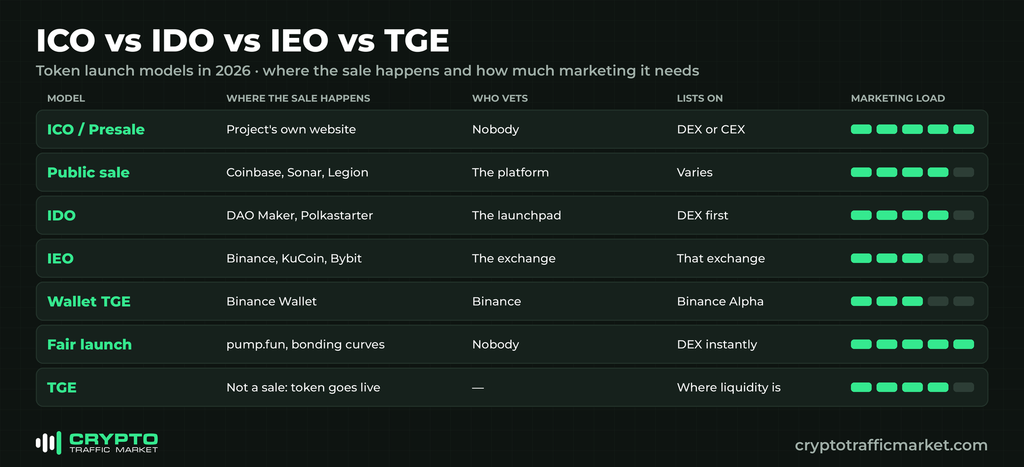
ICO vs IDO vs IEO vs TGE at a Glance
| Model | Where the sale happens | Who vets the project | Where the token lists | Marketing load on the project |
|---|---|---|---|---|
| ICO / presale | Project’s own website | Nobody — investors judge for themselves | DEX or CEX, arranged by the project | Very high |
| Public sale platform | Coinbase, Sonar, Legion, Buidlpad, MetaDAO | The platform | Varies; listing not guaranteed | High — demand must exist before applying |
| IDO | Decentralized launchpad (DAO Maker, Polkastarter, Seedify) | The launchpad | DEX, then CEX later | High |
| IEO | Exchange launchpad (Binance, KuCoin, Bybit) | The exchange | That exchange | Medium |
| Exchange-wallet TGE | Binance Wallet Exclusive TGE | Binance | Binance Alpha, possibly Binance later | Medium |
| Fair launch | Bonding-curve launchpads such as pump.fun | Nobody | DEX automatically | Extreme — marketing is everything |
| TGE | Not a sale — the token’s creation and first trading | — | Wherever liquidity and listings are set up | Peak on launch day |
ICO and Presale: Selling Directly to Investors
An ICO (initial coin offering) is the original model: the project sells tokens to the public before they trade. In 2026 most ICOs run as presales on the project’s own website, usually in stages with the price rising at each stage.
- Pros: full control of price, timing, and allocation; no launchpad fees or listing gatekeepers; the project keeps the relationship with every buyer.
- Cons: the project has to find every investor itself; no third party vouches for it; mainstream ads are closed — Google prohibits ICO ads, and X Ads bans ICOs, IEOs, and IDOs (see what X Ads allow for crypto).
- Best for: projects with an existing community, or teams willing to invest in several weeks of marketing before the sale opens.
Marketing carries the whole sale: Telegram and X communities, crypto media, KOLs, Bitcointalk, email, and trackers — see ICO and presale marketing.
Public Sale Platforms: The New ICO
Since 2025, public token sales have returned through curated platforms that handle KYC, select participants, and set rules against instant flipping:
| Platform | How it works | Notable facts |
|---|---|---|
| Coinbase Token Sales | Verified users commit USDC in a fixed window; smaller requests are filled first | Launched in November 2025 with US retail access — the first since 2018 — and plans for about one sale a month; buyers who sell within 30 days may get smaller future allocations, and issuers face a six-month lockup (The Block) |
| Sonar (Echo) | Infrastructure for sales on the project’s own site, with KYC and eligibility checks | Coinbase acquired Echo for $375 million in October 2025 (Decrypt); MegaETH and Plasma sold through Sonar |
| Legion | Participants scored on on-chain, social, and GitHub activity | Hosts MiCA-compliant sales on Kraken Launch (The Block) |
| Buidlpad | Campaigns with project-defined tiers, limits, and community allocations | Ran sales for Lombard and Falcon Finance |
| MetaDAO | Raises governed by market-based decision-making | Produced four of the six 2025–2026 token sales still trading above sale price (Finway) |
Demand is uneven. MegaETH’s sale drew over $1.39 billion in commitments against a target of about $50 million, while Monad’s sale on Coinbase was about 48% subscribed after its first hours and ultimately raised around $269 million (The Block).
Best for: well-known projects with a visible community and investors. Platforms select projects that already have demand — marketing has to create it before you apply.
IDO: Launching Through a Decentralized Launchpad
An IDO (initial DEX offering) runs the sale on a decentralized launchpad. Investors usually stake the launchpad’s token to reach an allocation tier, join with their wallets, and receive tokens at TGE, when the token lists on a DEX.
- Pros: access to the launchpad’s existing investor base; the launchpad’s vetting adds credibility; fast path to DEX trading.
- Cons: launchpad fees and token allocations; launchpads expect proof of community before accepting a project; early buyers often sell at listing.
- Best for: early-stage projects that need both capital and a first investor community.
Launchpads such as DAO Maker, Polkastarter, and Seedify look at social traction, so community growth on X and Telegram usually starts before the application.
IEO: Selling Through an Exchange
An IEO (initial exchange offering) runs the sale on an exchange’s own launchpad. The exchange vets the project, handles KYC, and lists the token after the sale.
- Pros: the exchange’s user base and credibility; a listing built into the sale; less marketing needed to reach buyers.
- Cons: hard to get selected; the exchange sets terms and timing; users from blocked jurisdictions, including the US on Binance Launchpad, can’t take part.
- Best for: established projects with strong traction and backers.
Binance Launchpad is still active, but its classic sales now share space with Launchpool and airdrop programs, so fixed-price sales are less frequent. KuCoin Spotlight and Bybit Launchpad also run IEOs (CryptoSlate).
Exchange-Wallet TGE: Binance Wallet and Binance Alpha
In March 2025, Binance opened applications for Binance Wallet Exclusive TGEs: token launches through the non-custodial Binance Wallet, with post-launch support through Binance Alpha, a pre-listing pool for the exchange. Binance prioritizes projects with proven demand, an active community, strong tokenomics, ties to the BNB Chain ecosystem, and a low or medium early valuation (Forklog).
Best for: projects that want a path toward Binance without a full IEO. As with launchpads, community traction comes first.
Fair Launch: No Sale at All
In a fair launch, there’s no presale or allocation — the token goes straight to trading, often on a bonding-curve launchpad like pump.fun, and the price rises as people buy. It’s the default for meme coins.
It’s also the hardest model to survive. Of 18.67 million tokens launched on pump.fun from January 2024 to June 2026, only 4.55% were still actively traded after 90 days (Blockchain App Factory). For meme coin promotion, marketing isn’t part of the launch — it is the launch.
TGE: The Moment the Token Goes Live
A TGE (token generation event) is the moment the token is minted, delivered to buyers, and starts trading. Every model above ends in a TGE, and some projects skip a sale entirely and go straight to TGE with an airdrop.
Launch day is where most of the risk sits. DWF Labs reported that 84.7% of 2025 launches traded below their TGE price. Airdrops are a particular challenge: day-90 retention averaged about 4% for snapshot airdrops versus 28% for points programs that reward sustained activity (Blockchain App Factory). See our token launch marketing plan for what to do before, during, and after TGE.
How Token Sales Have Performed Since 2025
The ICO revival hasn’t been kind to buyers. Of 41 token sales launched since the start of 2025, only six were trading above their sale price at the end of March 2026; most others had lost 46% to 98% (Finway). The ones that held tended to share the same traits: realistic valuations, a float the market could absorb, and demand built before the sale rather than after it.
For marketing, the lesson is simple: the sale isn’t the finish line. A community that stays after TGE matters more than the size of the raise.
Rules That Affect Each Model in 2026
- Advertising: Google prohibits ads for ICOs and token offerings, and X’s ad policy bans ICOs, IEOs, and IDOs (X Business). Token sales are promoted through crypto media, crypto ad networks, KOLs, and communities.
- European Union: under MiCA, public token offers require a published white paper, and marketing must be clearly identified, fair, and consistent with it.
- United States: in August 2026, the SEC proposed Regulation Crypto Assets, including a startup exemption for raises up to $5 million over four years and a fundraising exemption of up to $20 million or $75 million a year (Venable). It’s a proposal, not a final rule, and the CLARITY Act is still pending.
- Paid KOL posts: X requires its Paid Partnership label, and paid crypto promotions aren’t eligible in the EU, UK, and Australia.
This is a general overview, not legal advice. Check the rules in each country where you plan to sell tokens.
Which Launch Model Fits Your Project
| Your situation | Best-fit model | Why |
|---|---|---|
| Strong community, want full control | ICO / presale | No gatekeepers; you keep allocation and pricing |
| Well-known team, top-tier backers | Public sale platform or IEO | Curated access, credibility, broad distribution |
| Early-stage, need capital and first investors | IDO | Launchpad brings an investor base |
| BNB Chain project with traction | Binance Wallet Exclusive TGE | Path toward Binance Alpha and the exchange |
| Meme coin | Fair launch | Fast, permissionless; marketing decides everything |
| Product already live, no sale needed | Airdrop-led TGE | Rewards users; best with activity-based points |
What Marketing Each Model Needs
| Model | Marketing focus | When to start | Package |
|---|---|---|---|
| ICO / presale | Investor community, media coverage, KOLs, email, Bitcointalk, trackers | 2–4 weeks before the sale | Trial, Quick Start |
| Public sale platform | Visible demand before applying, then sale-week push | 4–8 weeks before applying | Quick Start, Standard |
| IDO | Social traction for the launchpad, allowlist campaign, launch-day push | 3–6 weeks before the IDO | Quick Start |
| IEO | Credibility, PR, community ahead of the exchange listing | 4–8 weeks before | Standard |
| Fair launch / meme coin | Constant X and Telegram activity, meme KOLs, DEX visibility | Before and from minute one | Quick Start |
| TGE and listings | Launch-week push, trackers, post-launch retention | 30+ days before TGE | Standard, Growth |
For a day-by-day pre-launch plan on X, see our 30-day X plan before a token launch.
Crypto Marketing Packages by Project Stage
Our packages cover presales, IDOs, IEOs, TGEs, and listings, with Telegram and X growth from real crypto-native audiences, crypto media, KOLs, and tracker listings:
| Package | Duration | Best for |
|---|---|---|
| Trial | 3 days | Pre-sale preparation, ICO/IDO, testing market response |
| Quick Start | 15 days | Pre-sale, IDO/IEO, DEX launch |
| Standard | 30 days | Token launch, DEX launch, first CEX listing |
| Growth | 45 days | Post-launch growth, new exchange listings, private or strategic round |
| Pro | 60 days | Major exchange listings, brand authority, long-term growth |
Not sure which model fits? Tell us your sale date and format, and we’ll show you what needs to be ready before it opens.
FAQ
What is the difference between an ICO, IDO, and IEO?
An ICO sells tokens directly from the project, usually on its own website; an IDO runs the sale on a decentralized launchpad before a DEX listing; an IEO runs the sale on an exchange’s launchpad, which vets the project and lists the token afterwards.
Is a TGE the same as an ICO?
No. An ICO is a sale; a TGE is the moment the token is created, delivered, and starts trading. A TGE follows an ICO, IDO, or IEO — or happens without any sale, for example with an airdrop.
Are ICOs still legal in 2026?
It depends on the country and the structure. In the EU, MiCA requires a published white paper for public token offers. In the US, the SEC proposed token offering exemptions in August 2026, but they aren’t final. Projects should get legal advice for each market they sell into.
Which is better for a new project: IDO or IEO?
For most early-stage projects, an IDO is more realistic: launchpads accept smaller projects with traction, while exchange IEOs usually require strong backers and an established community. An IEO brings more credibility and a built-in listing if you can get selected.
What are public token sale platforms?
Curated platforms such as Coinbase Token Sales, Sonar, Legion, and Buidlpad that run KYC-based public sales, select participants, and add rules against instant flipping. They brought ICO-style sales back in 2025, including US retail access on Coinbase.
Can you advertise an ICO or IDO?
Not on Google or through X Ads, which ban ICOs, IEOs, and IDOs. Token sales are promoted through crypto media, crypto ad networks, KOLs, Telegram, X, and Bitcointalk instead.
Which launch model is best for a meme coin?
Usually a fair launch on a bonding-curve launchpad, with no presale. It’s fast and permissionless, but only a small share of such tokens stay active after 90 days, so constant marketing on X and Telegram decides whether it survives.
How long before a token sale should marketing start?
At least 2–4 weeks before a presale or IDO, and 4–8 weeks before applying to a curated platform or exchange launchpad. Launchpads and platforms look for an existing community, so it has to be built before you apply.
Conclusion
ICO, IDO, IEO, and TGE aren’t competing buzzwords — they’re different answers to who sells your token, who vouches for it, and where it trades. In 2026 the menu is wider: curated public sale platforms, exchange-wallet launches, and fair launches sit next to the classic models. Whichever you choose, the pattern is the same: launchpads, platforms, and investors look for a real community first. Build it before the sale, keep it after TGE, and the launch model becomes a choice rather than a gamble.
 X Ads for Crypto in 2026: What's Allowed and When Organic Works Better
 Best Crypto Twitter Marketing Agencies in 2026
 How to Choose Crypto KOLs on X (and Spot Fake Influencers)
 Twitter Spaces for Crypto Projects: How to Host AMAs and Build a Community in 2026
 Crypto Twitter Engagement Strategy: Replies, Comments, and Threads That Work
 Real vs Bot Followers: How to Check a Crypto X Audience
 Is X Premium or Verified Organizations Worth It for Crypto Projects in 2026?
 X Shadowban for Crypto Projects: How to Check and Fix It in 2026
 How to Warm Up a New X (Twitter) Account for a Crypto Project in 2026


