
Quick answer: To get listed on a crypto exchange after TGE, build the signals exchanges screen for — steady DEX volume, real holders, an active community, CoinGecko and CoinMarketCap listings — then prepare a listing kit (audits, tokenomics, legal opinion, KYB documents), sign a market maker, and apply only through each exchange’s official portal. Binance now lists in stages (Binance Alpha, then Futures, then Spot), Coinbase says listing is free and merit-based, and tier-2 and tier-3 exchanges often charge fees or ask for marketing commitments. Expect 7–12 weeks from application to trading, and ignore anyone selling a “guaranteed listing.”
A DEX listing happens the moment your liquidity pool goes live. A centralized exchange listing has to be earned — and for most projects it’s the step that turns a token from a niche trade into something a broad crypto audience can buy. It brings deeper liquidity, new users, and credibility. It also brings due diligence, costs, and a market full of middlemen promising shortcuts that don’t exist.
This guide explains how to get listed on a crypto exchange after your TGE: when to apply, what exchanges look for, how Binance and Coinbase work today, what a listing really costs, and how to market around it. For the full launch process, see how to launch a crypto token.
When Is a Project Ready for a CEX Listing?
| Signal | What exchanges want to see |
|---|---|
| Trading history | Consistent DEX volume and tight spreads over weeks, not one launch-day spike |
| Holders | A growing, well-distributed holder base without heavy whale concentration |
| Community | Active X and Telegram with real engagement, not bought followers |
| Tracker listings | Live on CoinGecko and CoinMarketCap with accurate supply data |
| Security | Audited contracts with critical issues fixed |
| Tokenomics | Clear vesting, reasonable valuation, and an unlock schedule the market can absorb |
| Legal and compliance | KYB for the project and a legal opinion on the token’s status |
| Liquidity plan | A market maker ready to provide depth on the new pair |
Start with the trackers: our guides cover listing on CoinGecko and listing on CoinMarketCap.
Crypto Exchange Tiers
| Tier | Examples | What it brings | Estimated listing fee |
|---|---|---|---|
| Tier 1 | Binance, Coinbase, Kraken, OKX | The deepest liquidity and broadest reach; strongest credibility signal | $100,000–$3 million (Coinbase says it charges nothing) |
| Tier 2 | Bybit, KuCoin, Gate, HTX | Large global user bases; common first CEX for growing projects | $20,000–$300,000 |
| Tier 3 | Smaller regional and niche exchanges | First CEX presence and trading history | $0–$50,000, often with marketing or volume commitments |
Fee ranges are industry estimates compiled by crypto.news from industry sources and court filings; actual terms are confidential and vary by project. Most projects move up the tiers step by step rather than starting at the top.
How Binance Lists Tokens in 2026
In December 2025, Binance described a staged listing path (Motion Trade):
- Binance Alpha: an early discovery pool, traded through Binance Wallet, where selected tokens are watched for traction and on-chain activity. Alpha inclusion doesn’t guarantee a further listing.
- Binance Futures: a perpetual contract is often listed before spot, testing whether liquidity can support leveraged trading.
- Binance Spot: the final tier; higher-risk assets may carry a Seed Tag warning.
Binance says its listings are merit-based, with no shortcuts or paid fast-track options, that it never appoints intermediaries, and that projects that pay unofficial “agents” or “advisors” risk disqualification (The Cryptonomist). Parallel routes include Binance Wallet Exclusive TGEs, Launchpool, and HODLer Airdrops — see the best crypto launchpads.
How Coinbase Lists Tokens
Coinbase states that listing is free and merit-based, and it publishes its review criteria: legal compliance, technology security, market supply and demand, and team quality. Accepted assets appear on its public listing roadmap, and trading begins once market-making support and technical infrastructure are ready (The Block). Even without a fee, preparation — legal work, audits, market making — can cost a significant amount.
How to Get Listed on a CEX: 8 Steps
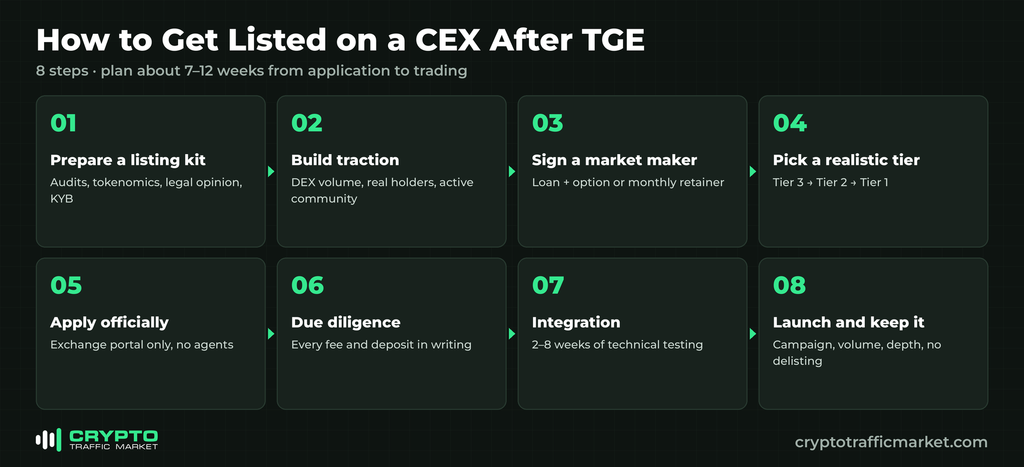
1. Prepare a listing kit
Audit reports (many exchanges expect two independent audits), tokenomics with vesting and unlock schedules, a legal opinion on the token’s status, KYB documents for the issuing entity, team background, and a one-page project summary.
2. Build traction and on-chain data
Exchanges screen trading history, holder distribution, and community activity. Keep the DEX market healthy, grow real holders, and keep X and Telegram active after the TGE spike — see the token launch marketing plan.
3. Sign a market maker
Most exchanges, and nearly all tier-1 venues, expect market-making coverage before approval. Common models are a token loan with call options or a monthly retainer; read terms and reporting obligations carefully.
4. Pick a realistic tier
Match the exchange to your stage. A strong tier-2 listing with real volume is worth more than a tier-1 application that waits months for a reply.
5. Apply only through official channels
Use each exchange’s listing application page and verified email domains. Anyone offering “insider” access is, at best, reselling a public form.
6. Go through due diligence and negotiate terms
Expect questions on regulatory status, security, tokenomics, and insider holdings. Clarify every cost in writing: listing fee, security deposit, marketing commitments, token allocations for exchange campaigns, and market-making requirements.
7. Complete technical integration
Wallet and deposit integration and testing typically take two to eight weeks. Overall, plan for about 7–12 weeks from application to trading.
8. Launch the listing — and keep it
Run a coordinated listing campaign, then protect the listing: exchanges monitor volume and order-book depth, and tokens with persistently weak liquidity risk monitoring tags or delisting.
What a CEX Listing Really Costs
| Cost | Typical range |
|---|---|
| Listing fee | From free (Coinbase, some tier-3 venues) to $100,000–$3 million at tier 1 (estimates) |
| Market making | $15,000–$50,000 per month for tier 1, plus a token loan for inventory |
| Security deposit | $500,000–$2 million at some tier-1 exchanges, returned if conditions are met |
| Legal and compliance | $50,000–$200,000 for a tier-1 listing |
| Audits | $5,000–$20,000 per audit for a simple token contract |
| Exchange campaigns | Token allocations for airdrops, trading competitions, or marketing commitments |
Estimates from crypto.news; individual terms are confidential and vary widely. For total first-year costs, crypto.news estimates $50,000–$500,000 for a tier-2 listing and $500,000–$5 million for tier 1.
Red Flags When Seeking a Listing
- “Guaranteed listing” agents. Binance says it never appoints intermediaries, and Coinbase says listing is free. Paid “insiders” are usually scammers.
- Volume packages. Offers to fake trading volume are wash trading — illegal in many jurisdictions and a fast route to delisting.
- Unwritten terms. Every fee, deposit, and token allocation should be in the contract.
- Listing before you’re ready. A listing with no volume, no community, and no market maker often ends in a monitoring tag and a falling price.
Marketing Around a CEX Listing
| When | What to do |
|---|---|
| Before applying | Grow real holders and community; keep DEX volume healthy; secure tracker listings and media coverage |
| Listing announcement | Announce on X, Telegram, and email; publish an article in crypto media; brief KOLs |
| Listing day | Coordinated push with KOLs, crypto ad networks, and community; team online; official links only |
| First 30 days | Support exchange campaigns, keep news flowing, prepare the next listing or milestone |
Our tracker listings service covers 30 platforms, and token launch marketing covers the campaigns around TGE and exchange listings. Keep in mind that Google and X Ads don’t accept most token promotions — see what X Ads allow.
Crypto Marketing Packages by Project Stage
| Package | Duration | Best for |
|---|---|---|
| Trial | 3 days | Pre-sale preparation, ICO/IDO, testing market response |
| Quick Start | 15 days | Pre-sale, IDO/IEO, DEX launch |
| Standard | 30 days | Token launch, DEX launch, first CEX listing |
| Growth | 45 days | Post-launch growth, new exchange listings, private or strategic round |
| Pro | 60 days | Major exchange listings, brand authority, long-term growth |
Preparing for your first or next exchange listing? Tell us the exchange and date, and we’ll plan the campaign around it.
FAQ
How do you get listed on a crypto exchange?
Build trading history, real holders, and an active community after TGE; list on CoinGecko and CoinMarketCap; prepare audits, tokenomics, a legal opinion, and KYB documents; sign a market maker; and apply through the exchange’s official listing page. Then complete due diligence, technical integration, and a listing campaign.
How much does it cost to list a token on an exchange?
It ranges from free (Coinbase and some smaller exchanges) to estimated listing fees of $20,000–$300,000 at tier-2 exchanges and $100,000–$3 million at tier 1, plus market making, legal work, audits, and sometimes security deposits. Actual terms are confidential.
How long does a CEX listing take?
Usually about 7–12 weeks from application to trading, including screening, compliance and KYB checks, and two to eight weeks of technical integration.
How do you get listed on Binance?
Binance lists in stages: tokens can enter Binance Alpha, then Binance Futures, then Spot. Projects apply through Binance’s official listing portal and are judged on security, tokenomics, compliance, traction, and ecosystem fit. Binance says it doesn’t use intermediaries or paid fast-track options.
Does Coinbase charge listing fees?
Coinbase says listing is free and merit-based, judged on legal compliance, technology security, market supply and demand, and team quality. Preparation costs such as legal work, audits, and market making still apply.
Do you need a market maker to list on a CEX?
For most exchanges, yes. Tier-1 exchanges in particular expect market-making coverage before approval, and exchanges monitor order-book depth after listing.
Should you pay a listing agent?
No. Binance says it never appoints intermediaries and may disqualify projects that pay unofficial agents, and Coinbase says listing is free. Apply directly through official channels.
Can a token be delisted after listing?
Yes. Exchanges review listed tokens and may add monitoring tags or delist tokens with persistently low volume, thin liquidity, or project problems. Keeping volume, liquidity, and community healthy after listing is part of the job.
Conclusion
Learning how to get listed on a crypto exchange is mostly learning what exchanges screen for: real trading, real holders, real community, clean security and legal work, and a market maker who keeps the order book healthy. Build those after TGE, apply through official channels, get every term in writing, and plan the marketing before the listing date — because the listing itself is only worth what the market does with it afterwards.
 Best Crypto Launchpads in 2026: IDO and Public Sale Platforms Compared
 How to Launch a Crypto Token in 2026: Step-by-Step
 Presale Marketing in 2026: What Actually Works
 ICO vs IDO vs IEO vs TGE: Which Token Launch Model Fits Your Project in 2026
 X Ads for Crypto in 2026: What's Allowed and When Organic Works Better
 Best Crypto Twitter Marketing Agencies in 2026
 How to Choose Crypto KOLs on X (and Spot Fake Influencers)
 Twitter Spaces for Crypto Projects: How to Host AMAs and Build a Community in 2026
 Crypto Twitter Engagement Strategy: Replies, Comments, and Threads That Work


