
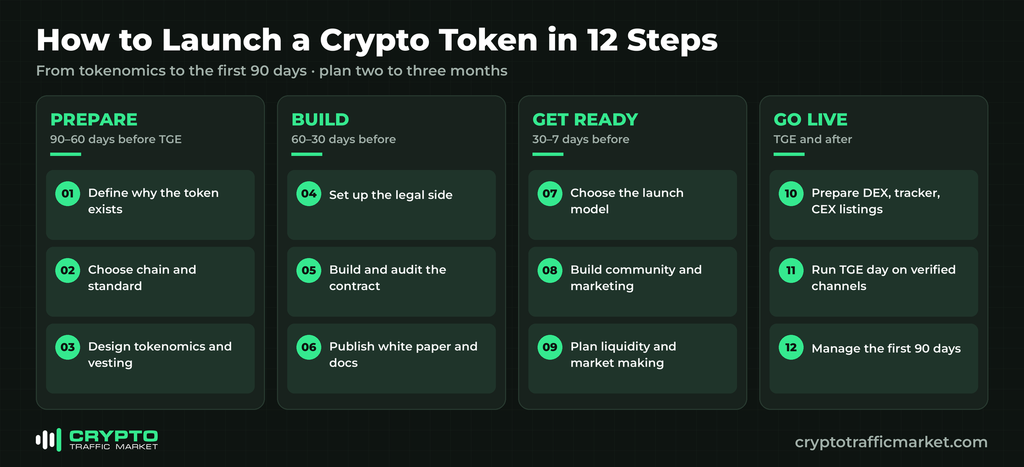
Quick answer: To launch a crypto token in 2026: define why the token exists, choose a blockchain and token standard, design tokenomics with real vesting, set up the legal side, build and audit the smart contract, publish a white paper and docs, choose a launch model (presale, public sale platform, IDO, IEO, or fair launch), build a community 30–90 days before TGE, plan liquidity and market making, prepare DEX, tracker, and exchange listings, run launch day with verified channels only, and keep marketing through the first 90 days. Creating the token takes hours; launching it well takes two to three months.
Creating a token is the easy part — on most blockchains it takes a few hours and a few hundred dollars. Launching one is different. Of 41 token sales since the start of 2025, only six traded above their sale price by March 2026 (Finway), and Memento Research found that 84.7% of 118 token launches in 2025 traded below their TGE valuation (Forklog). The difference between those and the few that held is rarely the code — it’s preparation.
This guide explains how to launch a crypto token in 12 steps, from the first tokenomics draft to the first 90 days of trading. For the marketing side of a launch, see our token launch marketing page.
Step 1: Define Why the Token Exists
Before any code, answer one question: what does the token do that the product can’t do without it? Common answers are access to features, staking and security, governance, rewards for users, or payment inside the product. A token that only exists to raise money is the first thing investors, launchpads, and exchanges look for — and the hardest thing for marketing to fix later.
Step 2: Choose a Blockchain and Token Standard
| Blockchain | Token standard | Typical for | Consider |
|---|---|---|---|
| Ethereum | ERC-20 | DeFi, infrastructure, high-value tokens | Highest credibility and liquidity; higher fees |
| Ethereum L2s (Base, Arbitrum, Optimism) | ERC-20 | Consumer apps, DeFi, social | Low fees, Ethereum tooling, growing user bases |
| Solana | SPL | Consumer apps, trading, meme coins | Fast and cheap; strong retail and meme coin activity |
| BNB Chain | BEP-20 | Retail-focused projects, GameFi | Close ties to Binance’s ecosystem, including Binance Wallet launches |
Choose the chain where your users and liquidity already are. Multi-chain launches add bridges, audits, and complexity — usually better after the token has found its first market.
Step 3: Design Tokenomics
Tokenomics decides who holds the token, when they can sell, and how much new supply hits the market. An illustrative allocation:
| Allocation | Typical share | Typical vesting |
|---|---|---|
| Community, ecosystem, and rewards | 30–50% | Released over several years |
| Team and advisors | 15–20% | 12-month cliff, then 24–36 months linear |
| Investors (private and public rounds) | 15–25% | Partial unlock at TGE, rest over 12–24 months |
| Treasury | 10–20% | Governed or time-locked |
| Liquidity and market making | 5–10% | Available at TGE |
These ranges are a starting point, not a standard. What matters most is the float at TGE — how many tokens can trade on day one — and the unlock schedule after it. A tiny float with a huge valuation looks good on paper and often ends with a long slide as unlocks arrive.
Step 4: Set Up the Legal Side
- Entity and jurisdiction. Most token issuers use a foundation or company in a crypto-friendly jurisdiction, separate from the development company.
- Token classification. Whether the token could be treated as a security depends on how it’s sold and what it does.
- European Union. Under MiCA, a public token offer requires a published white paper, and marketing must be clearly identified, fair, and consistent with it.
- United States. The SEC proposed token offering exemptions in August 2026, including a startup exemption for raises up to $5 million over four years; they aren’t final yet.
- KYC. Public sales and many launchpads require KYC for buyers and KYB for the project.
This is a general overview, not legal advice. A crypto lawyer for each target market is one of the cheapest insurances in a launch budget.
Step 5: Build and Audit the Smart Contract
Use well-tested standard implementations, keep custom logic minimal, and get an independent audit before launch. Typical 2026 audit prices are $5,000–$20,000 for a simple token contract and $25,000–$100,000 for most DeFi protocols, with re-audits after fixes adding $5,000–$20,000 (Sherlock). Publish the audit report — investors check for it.
Also decide who controls the contract: use a multisig for admin keys, renounce or time-lock permissions you don’t need, and document it publicly.
Step 6: Publish a White Paper, Docs, and Website
Investors, launchpads, and exchanges will read three things: a white paper or litepaper explaining the problem, product, and token; a tokenomics page with allocation and vesting; and a website that makes the team and roadmap clear. In the EU, the white paper is also a legal requirement for public offers.
Step 7: Choose a Launch Model
| Model | How it works | Best for |
|---|---|---|
| Presale / ICO | Tokens sold from your own website, usually in price stages | Projects with a community and full control |
| Public sale platform | Curated sale on Coinbase, Sonar, Legion, or Buidlpad | Well-known teams with visible demand |
| IDO | Sale on a decentralized launchpad, then DEX listing | Early-stage projects needing capital and investors |
| IEO | Sale on an exchange launchpad, with listing built in | Established projects with strong traction |
| Binance Wallet TGE | Launch through Binance Wallet with support via Binance Alpha | Projects with traction, often BNB Chain |
| Fair launch | No sale; trading starts immediately, often on a bonding curve | Meme coins |
| Airdrop-led TGE | No sale; tokens distributed to users | Products already live with real users |
For a full comparison, see ICO vs IDO vs IEO vs TGE. If you’re running a token sale, see ICO and presale marketing and our guide to crypto presale marketing.
Step 8: Build a Community and Start Marketing 30–90 Days Before TGE
Launchpads, exchanges, and public sale platforms all look for proof of demand before they accept a project — and buyers look for it before they buy. That means an active X account, a Telegram community where questions get answered, coverage in crypto media, tracker listings, and KOLs who understand the project, all in place before launch day.
- For the full timeline, see our token launch marketing plan.
- For X specifically, use the 30-day X plan before a token launch.
- For KOLs, see how to choose crypto KOLs.
Keep in mind that Google and X don’t accept ads for ICOs, IEOs, or IDOs, so pre-launch marketing runs through communities, crypto media, KOLs, and crypto ad networks.
Step 9: Plan Liquidity and Market Making
A token needs enough liquidity for people to buy and sell without the price swinging wildly. On a DEX, that means seeding a pool and locking the liquidity tokens so buyers can see it can’t be pulled. On centralized exchanges, most projects work with a market maker, usually in one of two models (Arrakis):
| Model | How it works | Watch out for |
|---|---|---|
| Loan + call option | The project lends 1–5% of supply for 12–24 months; the market maker gets options at set strike prices | The market maker may sell loaned tokens; terms and execution are often opaque |
| Retainer | The project provides tokens and stablecoins and pays a fixed fee, about $3,000–$7,000 per month per exchange | More upfront capital; fewer market makers accept it |
Thin order books are expensive: tokens with under $20,000 in 2% depth showed average volatility of 237%, versus 171% for tokens with $165,000 or more. Read every market maker contract carefully, and ask for regular reporting.
Step 10: Prepare Listings
- DEX: the token trades as soon as the liquidity pool goes live; DEX Screener and DEXTools pick it up automatically.
- Trackers: apply to CoinGecko and CoinMarketCap as soon as the token trades — see our guides on listing on CoinGecko and listing on CoinMarketCap.
- Centralized exchanges: negotiate early. Exchanges look at community, volume, liquidity, and security; many smaller exchanges charge listing fees, and top-tier exchanges are selective.
- Other trackers and calendars: list on token calendars and tracker platforms to be found by investors — our tracker listings service covers 30 platforms.
Step 11: Run TGE Day
- Publish the contract address only through verified channels — website, verified X account, pinned Telegram message. Fake contract addresses appear within minutes of any launch.
- Warn the community about scams: the team never DMs first, and there is only one official claim page.
- Keep the team online in shifts to answer questions on X and Telegram.
- Host a live X Space with the official contract address pinned — see Twitter Spaces for crypto.
- Time KOL posts and announcements for the moment trading opens, not days later.
Step 12: Manage the First 90 Days
Launch day is the start, not the finish. The first 90 days decide whether buyers stay. Airdrops show the risk: day-90 retention averaged about 4% for snapshot airdrops versus 28% for points programs that reward sustained activity (Blockchain App Factory).
- Keep posting, hosting Spaces, and answering questions after the launch spike fades.
- Announce unlocks early and explain them — surprise unlocks hurt more than planned ones.
- Reward holders and active users rather than one-time claimers.
- Prepare the next listing or product milestone so there’s news after TGE.
Token Launch Timeline
| When | What to finish |
|---|---|
| 90–60 days before TGE | Purpose, chain, tokenomics draft, legal setup, contract development |
| 60–30 days before | Audit, white paper and docs, launch model chosen, community and marketing started |
| 30–7 days before | Sale or launchpad round, KOLs booked, liquidity and market maker agreed, listings prepared |
| Launch week | TGE, liquidity live, tracker applications, launch-day marketing push |
| First 90 days | Retention, unlock communication, next listings and milestones |
How Much It Costs to Launch a Crypto Token
| Item | Typical cost |
|---|---|
| Token contract deployment | From a few hundred dollars, depending on the chain |
| Smart contract audit | $5,000–$20,000 for a simple token; $25,000–$100,000 for DeFi |
| Legal setup | Varies widely by jurisdiction and sale structure |
| Liquidity | Project capital in the pool; size depends on the expected volume |
| Market maker | 1–5% of supply as a loan, or about $3,000–$7,000 per month per exchange on retainer |
| Marketing | From $175 + $100 in tokens for a 3-day Trial to $12,500 + $8,000 in tokens for a 60-day Pro campaign |
| Exchange listings | From free on DEXs to significant fees on some centralized exchanges |
For marketing budgets in more detail, see how much crypto marketing costs.
Common Token Launch Mistakes
- Starting marketing when the sale opens instead of weeks before.
- A tiny float with a huge valuation and a heavy unlock schedule.
- No audit, or an audit nobody can find.
- Thin liquidity and an unchecked market maker contract.
- Bought followers and empty Telegram groups that investors spot instantly.
- Going quiet after TGE, so buyers sell into the silence.
Crypto Marketing Packages by Project Stage
Our packages cover each stage of a launch, with Telegram and X growth from real crypto-native audiences, crypto media, KOLs, and tracker listings:
| Package | Duration | Best for |
|---|---|---|
| Trial | 3 days | Pre-sale preparation, ICO/IDO, testing market response |
| Quick Start | 15 days | Pre-sale, IDO/IEO, DEX launch |
| Standard | 30 days | Token launch, DEX launch, first CEX listing |
| Growth | 45 days | Post-launch growth, new exchange listings, private or strategic round |
| Pro | 60 days | Major exchange listings, brand authority, long-term growth |
Launching a meme coin? See meme coin marketing. Planning a TGE? Tell us your launch date, and we’ll show you what needs to be ready before it.
FAQ
How do you launch a crypto token?
Define the token’s purpose, choose a blockchain, design tokenomics with vesting, set up the legal side, build and audit the smart contract, publish a white paper, choose a launch model, build a community before TGE, plan liquidity and market making, prepare listings, run launch day through verified channels, and keep marketing through the first 90 days.
How much does it cost to launch a crypto token?
Deploying the contract can cost a few hundred dollars, but a full launch usually includes an audit ($5,000–$20,000 for a simple token), legal setup, liquidity, a market maker, and marketing. Marketing packages range from $175 plus $100 in tokens for a 3-day test to $12,500 plus $8,000 in tokens for a 60-day campaign.
How long does it take to launch a token?
Creating the token takes hours. Preparing a launch properly — tokenomics, legal, audit, community, liquidity, and listings — usually takes two to three months.
Which blockchain is best for launching a token?
The one where your users and liquidity already are. Ethereum and its L2s suit DeFi and infrastructure, Solana suits consumer apps and meme coins, and BNB Chain suits retail-focused projects and offers a path to Binance Wallet launches.
Do you need an audit to launch a token?
It isn’t legally required everywhere, but investors, launchpads, and exchanges expect one. A published audit from a known firm is one of the first things buyers check.
Do you need a market maker for a token launch?
For a DEX-only launch, locked liquidity may be enough at first. For centralized exchange listings, most projects use a market maker, either through a token loan with call options or a monthly retainer, and should review the contract and reporting terms carefully.
When should token launch marketing start?
Thirty to ninety days before TGE. Launchpads, exchanges, and buyers all look for an active community before launch, so it has to be built in advance.
What is the most common reason token launches fail?
Weak preparation rather than code: marketing that starts too late, a small float with a high valuation and heavy unlocks, thin liquidity, and a community that goes quiet after TGE.
Conclusion
Knowing how to launch a crypto token in 2026 means knowing that the token is the smallest part of the launch. Purpose, tokenomics, legal, audit, community, liquidity, listings, and the first 90 days decide whether it holds. Give the launch two to three months, build demand before you ask anyone to buy, and plan what happens after TGE before the day arrives — that’s what the few successful launches of 2025 and 2026 had in common.
 Presale Marketing in 2026: What Actually Works
 ICO vs IDO vs IEO vs TGE: Which Token Launch Model Fits Your Project in 2026
 X Ads for Crypto in 2026: What's Allowed and When Organic Works Better
 Best Crypto Twitter Marketing Agencies in 2026
 How to Choose Crypto KOLs on X (and Spot Fake Influencers)
 Twitter Spaces for Crypto Projects: How to Host AMAs and Build a Community in 2026
 Crypto Twitter Engagement Strategy: Replies, Comments, and Threads That Work
 Real vs Bot Followers: How to Check a Crypto X Audience
 Is X Premium or Verified Organizations Worth It for Crypto Projects in 2026?


