Quick answer: To list a token on CoinMarketCap, it must already trade on at least one CMC-tracked exchange, show genuine daily volume (roughly $50,000 as a working floor), have a functioning website and a public block explorer page, and be submitted through CoinMarketCap’s official request form with data that matches across every source. Standard review typically runs from a few days to several weeks; a paid fast-track option exists but does not lower the bar. Most rejections come down to thin liquidity, incomplete applications, or ticker conflicts — not bad luck.
A CoinMarketCap listing is one of the few moments where a crypto project stops being a claim and becomes a verifiable data point. Investors who have never heard of a token will still trust a CMC page over a project’s own landing page, because the numbers there come from exchanges rather than from the team. That’s why it sits near the top of almost every early-stage visibility checklist — and why we covered the broader landscape in Top 5 Crypto Trackers, Listings & Rating Platforms.
This guide covers the specific path to CoinMarketCap: what the platform actually requires, what the process looks like end to end, how long it takes, what it costs, and where applications typically fail.
Why a CoinMarketCap Listing Matters
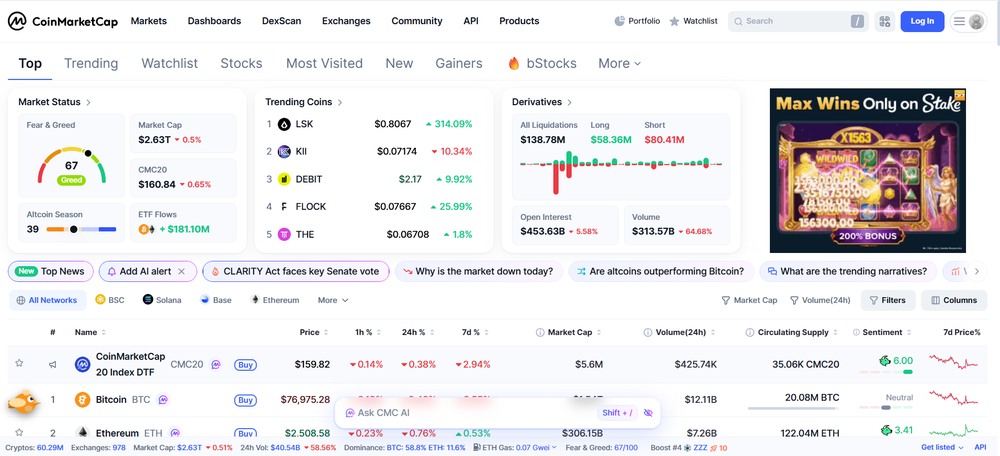
CoinMarketCap is the highest-traffic price aggregator in crypto by a wide margin, and for a large share of retail investors it functions as the default reference point — the place they check before anything else. A listing changes three things for a project:
- Discoverability. The token becomes searchable inside the same interface people already use to research every other asset, instead of existing only where the project promotes it.
- Perceived legitimacy. Passing CMC’s review is a basic credibility filter. It isn’t an endorsement, but its absence is frequently read as a red flag.
- Downstream integrations. A live CMC page is often a prerequisite for price and logo display across wallets, portfolio trackers, and other aggregators that pull from CMC’s dataset.
CoinMarketCap Listing Requirements
CoinMarketCap reviews applications manually, and the review is essentially a verification exercise: does this token exist, does it trade for real, and does the information the team submitted hold up against independent sources. The practical requirements:
| Requirement | What it means in practice |
|---|---|
| Live on a tracked exchange | The token must already trade on at least one exchange CoinMarketCap tracks and pulls data from via API. Two or three tracked markets materially improve the odds. |
| Genuine trading volume | Around $50,000 in honest daily volume is the commonly cited working floor. Sustained volume over consecutive days reads far better than a single spike. |
| Real order book liquidity | Tight spreads, meaningful size on both bid and ask sides, and depth across multiple price levels — not a thin book propped up by two orders. |
| Working website | Live, functional, and consistent with everything submitted in the form. |
| Public explorer page | The contract must be visible and verifiable on a block explorer for its chain. |
| Unique ticker symbol | A symbol that collides with an existing listed asset is a common and avoidable rejection reason. |
| Complete, consistent application | Name, symbol, contract address, supply figures, official links, and team contacts must match across the form, the website, and the explorer. |
The consistency point deserves emphasis. Most of what CMC’s reviewers do is cross-check: the supply figure in the form against the contract, the links in the form against the live site, the ticker against their existing database. A mismatch anywhere turns a straightforward approval into a round of follow-up questions — or a rejection.
How to List a Token on CoinMarketCap: Step by Step
Step 1 — Get the token trading on a tracked exchange
Nothing else in this process matters until the token has a live market on an exchange CoinMarketCap actually pulls data from. CMC maintains a public ranking of the exchanges it tracks, and only markets on those venues count toward an application. Projects sometimes list on a venue CMC doesn’t track and then wonder why the application stalls — check the exchange against CMC’s list before committing to a listing fee.
Step 2 — Build volume and liquidity that survive scrutiny
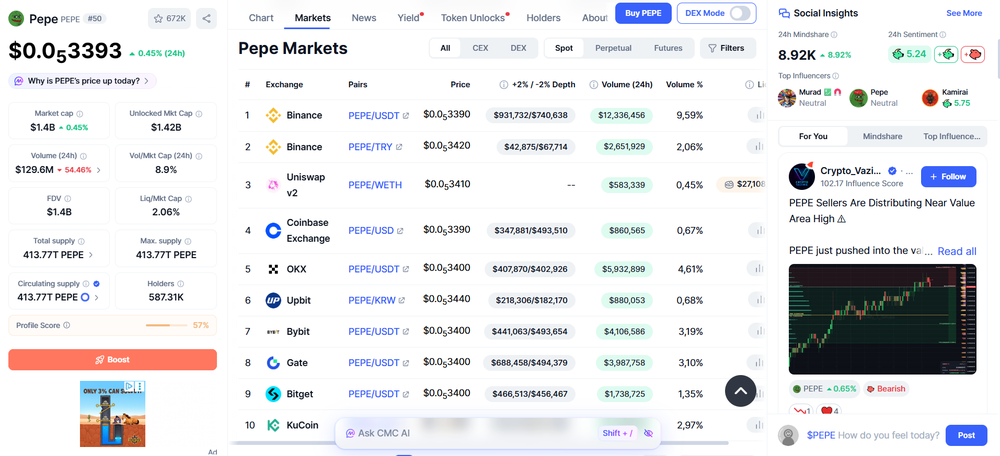
The $50,000 daily volume figure is a floor, not a target. Applications backed by consistent volume over a run of consecutive days present far better than ones that clear the threshold for a single day. On the liquidity side, what reviewers look at is whether a real buyer or seller could transact without moving the price wildly: keep the spread tight, maintain meaningful order size on both sides close to mid-price, and populate the book with multiple distinct orders rather than a handful of large ones.
For tokens whose primary market is a DEX rather than a centralized exchange, the equivalent question is pool depth — a shallow pool produces the same effect as a thin order book, and is equally visible to anyone checking.
Step 3 — Submit the official request form
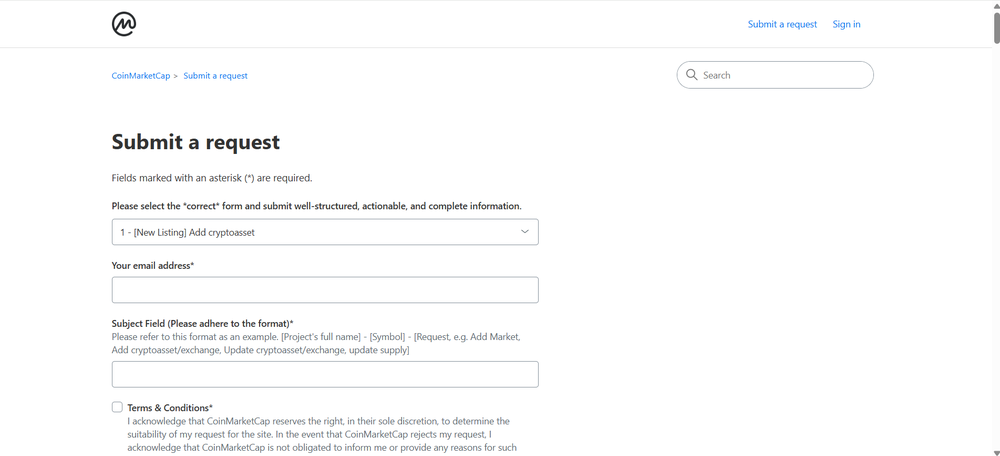
Applications go through CoinMarketCap‘s support request system, using the form type for adding a new crypto asset. A few practical notes:
- Submit from the project’s official domain email, not a personal address — mismatched sender domains create immediate friction.
- Follow the subject-line format CMC specifies exactly. Forms that deviate get deprioritized in the queue.
- Fill every field with data that can be independently verified. Blank or approximate entries are the single most common cause of back-and-forth delays.
- Save the ticket number from the automated confirmation email — every follow-up references it.
Step 4 — Track the application and respond fast
After submission, the project receives an automated acknowledgment with a ticket ID. A reviewer may then request clarification, additional documentation, or proof of activity. Response speed matters here more than most teams expect: a ticket that sits unanswered for days goes back to the end of a queue that may already be long.
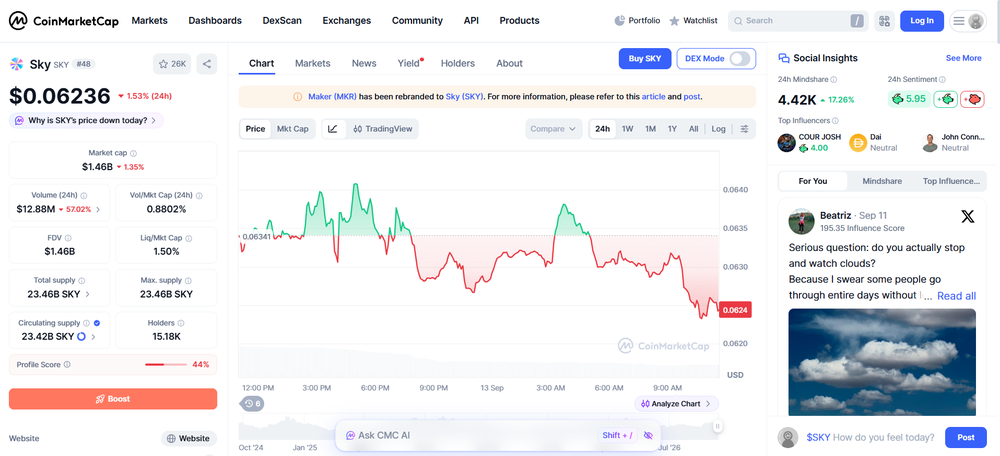
To check whether a token has gone live, search the contract address directly in CoinMarketCap’s search — it will surface the asset page once it’s published.
How Long Does a CoinMarketCap Listing Take?
For a clean, complete application on a token that clearly meets the thresholds, approval commonly lands within a couple of weeks. But the honest range is wider, and it depends on factors mostly within a project’s control:
- Application quality. Complete and internally consistent submissions move fastest. Every follow-up question adds a cycle.
- Queue volume. During bull markets, application backlogs grow substantially and timelines stretch. Applying during a quieter market period is an underrated advantage.
- Complexity. Unusual token structures, multi-chain deployments, or ambiguous supply models all extend review.
CMC Priority: The Paid Fast-Track
CoinMarketCap offers a paid priority service for projects that need a guaranteed response window rather than an open-ended wait. The important thing to understand is what it does and doesn’t buy:
- It buys speed of review — a committed turnaround rather than a place in the general queue.
- It does not buy approval. The same requirements apply. A token with thin liquidity and an incomplete form will be rejected faster, not accepted.
Pricing has been reported in the low thousands of dollars and is set by CoinMarketCap directly, so confirm the current figure with them rather than relying on any third-party quote. For projects where the listing is not time-critical, the free queue reaches the same outcome.
A security note that matters: the paid track involves emailed payment links, which makes it a natural target for impersonation. Before acting on any payment instruction, verify the sender domain, confirm the ticket number matches the one from the original submission, and check any payment address against a block explorer for a plausible transaction history. Never share anti-phishing codes with third parties. This is one of the few places in the listing process where a mistake costs real money.
Why CoinMarketCap Applications Get Rejected
| Reason | What to do about it |
|---|---|
| Insufficient volume or liquidity | Build genuine market activity before reapplying. Reapplying with the same thin book produces the same result. |
| Incomplete or inconsistent information | Audit every field against the contract, the website, and the explorer before resubmitting. |
| Ticker symbol conflict | A symbol that duplicates or closely resembles a listed asset is difficult to resolve after launch — check availability before the token generation event, not after. |
| Legitimacy concerns | Missing team information, no audit, unverifiable claims, or an unverified contract all read as risk. Fix the underlying gaps rather than reframing them. |
| Non-standard asset type | CMC’s core dataset is fungible tokens with exchange markets. Assets that don’t fit that model face a much higher bar. |
After the Listing: What Most Projects Skip
Getting listed is the start of the work, not the end of it. A CMC page that goes stale actively undercuts the credibility the listing was meant to build. Three things worth maintaining:
- Add new markets as they go live. Each additional tracked market strengthens the data behind the page and is submitted through a separate form. Additional markets also factor into unlocking full market-cap display.
- Keep circulating supply current. Market cap and ranking depend on an accurate circulating supply figure, and this is where a large share of listed projects quietly fall behind — an outdated supply number produces a wrong market cap on the single page most investors check.
- Keep profile data fresh. Logos, links, descriptions, and social handles all drift over time. Updating them is low effort and directly affects how the project reads to a first-time visitor.
CoinMarketCap Is One Listing, Not a Strategy
A single listing on a single aggregator reaches one slice of an audience. Traders default to CoinMarketCap and CoinGecko; investors evaluating a raise look at fundraising-focused platforms; on-chain users look at activity-based rankings. Projects that treat CMC as the finish line tend to be invisible everywhere else.
Our Crypto Trackers & Listings service handles submissions across the full set of trackers, listing platforms, and rating sites appropriate to a project’s stage — preparing the data package once, submitting it correctly to each platform’s specific requirements, and keeping profiles current afterward so they don’t decay. For the broader picture of which platforms are worth the effort, see Crypto Trackers, Listings and Rankings.
FAQ: Listing a Token on CoinMarketCap
What are the minimum requirements to list a token on CoinMarketCap?
The token must trade on at least one CoinMarketCap-tracked exchange, show genuine daily trading volume (roughly $50,000 as a commonly cited floor), maintain real order book liquidity, have a live website and a public block explorer page for the contract, use a ticker that doesn’t conflict with an existing asset, and be submitted with complete, consistent information through CMC’s official request form.
How long does it take to get listed on CoinMarketCap?
A clean application on a token that clearly meets the thresholds often clears within a couple of weeks, but the range is wider in practice. Timeline depends primarily on application completeness, how quickly the team answers follow-up questions, and how large CoinMarketCap’s review backlog is at the time — backlogs grow noticeably during active market periods.
Can I get listed on CoinMarketCap for free?
Yes. The standard application process carries no fee from CoinMarketCap. The paid priority service only buys a faster review window, not a different outcome — projects that aren’t working against a hard deadline reach the same place through the free queue.
Does paying for CMC Priority guarantee a listing?
No. Priority affects review speed, not the criteria. A token with thin liquidity or an incomplete application gets rejected either way — paying simply means finding out sooner. Treat it as a scheduling tool, not an approval mechanism.
Why was my CoinMarketCap application rejected?
The most frequent causes are insufficient trading volume or liquidity, incomplete or inconsistent information across the form, website and explorer, a ticker symbol that collides with an existing listing, and unresolved legitimacy concerns such as an unverified contract or missing team information. Each of these is fixable, but resubmitting without addressing the underlying issue produces the same result.
Do I need to be on CoinMarketCap before CoinGecko?
No — they’re independent platforms with separate applications and separate review processes. Most projects apply to both once a token is actively trading, since traders and investors default to different aggregators and being on only one leaves a meaningful share of the audience unable to find the token where they look.
What happens after a token is listed on CoinMarketCap?
The page goes live, but it needs maintenance. New trading pairs have to be submitted as separate market additions, circulating supply needs updating for market cap and ranking to display correctly, and profile details drift over time. A stale CMC page is a common and avoidable problem — it undermines exactly the credibility the listing was meant to establish.
Conclusion
Listing on CoinMarketCap is less about knowing a secret process and more about arriving prepared: a real market on a tracked exchange, liquidity that holds up under inspection, and an application where every field can be independently verified. Projects that clear those three bars usually get listed without drama. Projects that treat the form as the first step rather than the last one spend weeks in a follow-up loop — or get rejected and reapply with the same gaps. And once the page is live, keeping it accurate matters more than most teams expect, because for a large share of investors that page is the project.
 Top 5 Crypto Media Outlets Worth Your Project's Attention in 2026
 Top 5 Crypto Trackers, Listings & Rating Platforms Worth Your Project's Attention in 2026
 Crypto Trackers, Listings and Rankings: Why Every Web3 Project Needs to Be on CoinMarketCap, CoinGecko and More
 Email Marketing for Crypto and Web3 Projects: How to Attract Investors, Users, and Community Through Email
 How Much Does Crypto Marketing Cost in 2026? Full Budget Breakdown for Web3 Projects
 Meme Coin Growth Marketing Strategy in 2026: From a Viral Tweet to Billion-Dollar Market Cap
 GameFi Growth Marketing Strategy for 2026
 Growth Marketing Strategy for DeFi Projects in 2026
 How to Build Trust Infrastructure for a Crypto Project in 2026