
Quick answer: A Binance Alpha listing is the first stage of Binance’s three-step path: Alpha, then Futures, then Spot. Projects enter Alpha through an exclusive Binance Wallet TGE, a Pre-TGE or Prime Sale, a Booster campaign, an Alpha airdrop, or a direct Alpha featuring. Binance says it charges no fee for listing applications, accepts them only from founders or key team members through its official form, and blacklists projects that use agents. It evaluates product quality, user metrics, tokenomics, team, technical risk, and compliance — plus volume, liquidity, and holder distribution for tokens already trading. Alpha is a start, not a guarantee: in a 2025 IOSG Ventures sample, 37.8% of Alpha tokens reached Binance Futures and 12.2% reached Spot.
For a token launch in 2026, Binance Alpha is the closest thing to a front door at the world’s largest exchange. It’s where Binance introduces early-stage tokens to its users, runs exclusive TGEs and airdrops, and watches which projects earn a place on Futures and Spot. It’s also where many founders get lost: in points mechanics, in launch formats with similar names, and in offers from “agents” who claim they can get a token in.
This guide explains how a Binance Alpha listing works for projects: what Alpha and the Binance Wallet TGE are, how each entry format works, what Binance evaluates, how to apply, what happens after Alpha, and how to prepare the community and market around it. For the full launch campaign, see our token launch marketing page.
What Is Binance Alpha?
Binance Alpha is Binance’s pool of early-stage tokens that haven’t been listed on Binance Spot. It launched in December 2024 inside Binance Wallet, and since Alpha 2.0 in March 2025 users can buy Alpha tokens directly in the main Binance app (Coin Bureau). Tokens trade on-chain, mostly on BNB Chain, and since February 2026 users can also withdraw supported Alpha tokens to external wallets (CoinMarketCap).
On 17 December 2025, Binance formalized Alpha as the first of three listing stages (Binance):
| Stage | What it is | What it means for a project |
|---|---|---|
| Binance Alpha | The initial stage where projects are introduced to the community, including Pre-TGEs and Alpha Airdrops | Visibility to Binance users, on-chain trading in the Binance app, and a track record Binance can measure |
| Binance Futures | Perpetual contracts for projects that perform well and meet key criteria | Much more trading volume and attention — and short sellers |
| Binance Spot | Full listing with complete market access and liquidity | The main listing; projects can be listed here directly or promoted from earlier stages |
Binance Alpha Formats for Projects
“Getting on Binance Alpha” can mean several different events. They differ in who takes part, what the project gives, and what users need:
| Format | How it works | What the project gives | What users need |
|---|---|---|---|
| Exclusive Binance Wallet TGE | A token sale run through Binance Wallet with PancakeSwap, usually in a 2-hour subscription window; trading opens on Alpha right after | A token allocation for the sale; often extra tokens for later campaigns | Alpha Points above the event threshold (points are deducted), plus BNB to commit |
| Pre-TGE / Prime Sale | A sale before the token generation event, with tokens claimed at or after TGE | A sale allocation before the token trades | Alpha Points — about 240+ points for the February 2026 Espresso Prime Sale |
| Booster campaign | Users complete on-chain tasks (staking, deposits, trading) for a token reward pool | A reward pool, e.g. 2% of total supply for Treehouse in 2025, often with vesting or lock-ups | A Binance Wallet; many Booster campaigns have no points threshold |
| Alpha airdrop / Alpha Box | Users claim free tokens with Alpha Points; Alpha Box pools tokens from several projects into one claim | Airdrop tokens | Alpha Points above the threshold — 242 for the February 2026 Alpha Box |
| Alpha featuring | A token that already trades on-chain is added to Alpha | Usually no allocation; Binance evaluates the token’s traction | Nothing special — users simply buy and sell |
Sources: Binance Treehouse Booster announcement, CoinMarketCap.
How a Binance Wallet TGE Works
Exclusive TGEs are Binance Wallet’s main launch format. In April 2026, the OpenGradient TGE was announced as the 46th exclusive TGE (crypto.news). The flow for users is usually:
- Announcement. Binance Wallet announces the project, the date, the points threshold, and the token amount on offer.
- Subscription. In a 2-hour window, eligible users commit BNB. Joining costs Alpha Points — 15 points per event was typical in early 2026.
- Allocation. If the sale is oversubscribed, users receive a pro-rata share and unused BNB is returned.
- Claim and trading. Tokens are claimed and start trading on Binance Alpha, often at the same moment the subscription closes.
Why Alpha Points matter to projects
Users earn Alpha Points from their balances and from buying Alpha tokens, and only points earned in the last 15 days count. Thresholds for recent events have been around 220–242 points (CoinMarketCap). The result is a large audience of active users who move from event to event — many of them farming points and allocations rather than looking for a project to hold. A Binance Wallet TGE brings real distribution and volume, but it doesn’t bring a loyal community by itself. That part still has to be built before and after the event.
What Binance Looks For
Binance says progression through Alpha, Futures, and Spot depends on a “comprehensive evaluation,” with the final decision resting with Binance. The areas it names (Binance):
| Area | What it means in practice |
|---|---|
| Product quality | A working product people actually use, not just a roadmap |
| User metrics | Active users, wallets, on-chain activity, and community size and engagement |
| Tokenomics | Supply, allocation, vesting, and unlocks that don’t flood the market |
| Team background | An identifiable team with a relevant track record |
| Technical risk | Audited contracts and a sound architecture |
| Compliance | KYC/KYB documents and a clean legal setup |
| Trading data (tokens already trading) | Trading volume, liquidity, and how widely the token is distributed |
Most of these signals are visible from outside. Community size and engagement on X and Telegram, holder distribution, DEX liquidity, and tracker pages on CoinGecko and CoinMarketCap are among the first things anyone reviewing a project checks.
How to Apply for a Binance Alpha Listing
Binance has three official application channels: the general Spot listing form, the Futures listing form, and the Binance Alpha application form, all linked from its listing announcement. The rules are strict:
- Apply directly. Applications must come from the founder or a key team member, with complete information and KYC.
- No fees. Binance says it “does not charge any fee for project evaluations or listing applications.”
- No agents. Binance says it does not appoint, accept, or endorse any individual or agency to apply for a listing. Using an intermediary leads to immediate disqualification and blacklisting, and Binance published a list of blacklisted intermediaries and offers a whistleblower bounty of up to $5 million.
- No guarantees. Anyone promising a guaranteed Alpha, Futures, or Spot listing is selling something Binance itself doesn’t offer.
Free to apply doesn’t mean free to launch. Exclusive TGEs, Booster campaigns, and airdrops are paid for in tokens, and most projects also need an audit, a market maker, and a marketing budget around the event. For typical figures, see token launch marketing cost.
The Path From Alpha to Futures and Spot
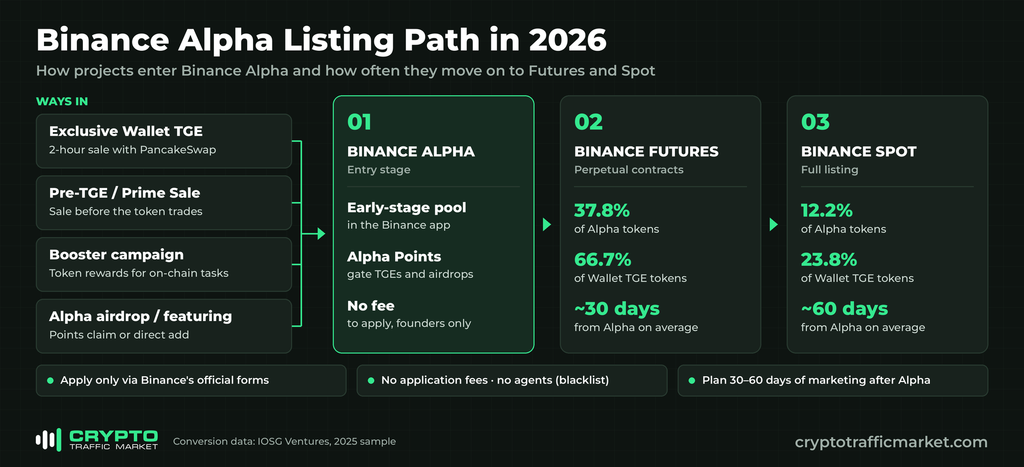
Alpha is the first step, and most tokens stop there. Two studies show the scale:
| Route | Reached Futures | Reached Spot | Average wait |
|---|---|---|---|
| Binance Alpha | 37.8% (31 of 82) | 12.2% (10 of 82) | About 30 days to Futures, about 60 days to Spot |
| Binance Wallet TGE | 66.7% (14 of 21) | 23.8% (5 of 21) | About 17 days to Futures or Spot |
Source: IOSG Ventures study of Binance listings after February 2025. An earlier DWF Ventures analysis found that 18 of more than 190 Alpha tokens (about 9.5%) had reached Spot by June 2025, and that about 70% of Alpha tokens had market caps below $50 million.
Two takeaways for founders. First, an exclusive Wallet TGE converts to Futures and Spot far more often than a plain Alpha featuring — those projects are selected more strictly. Second, the window is short. If a token is going to move up, it usually happens within one to two months, so traction has to be strong from the first week, not built later.
Price after an Alpha listing
An Alpha listing is not a price catalyst. In the same IOSG study, the median token was down 7.6% from its listing-day valuation 14 days after an Alpha listing, and down 16.3% after a Binance Wallet TGE; the averages were positive only because a few tokens surged. Airdrop and points farmers sell, early allocations unlock, and the price finds its level. Projects that hold up are the ones with buyers who came for the product — the community built before the event.
How to Prepare a Project for Binance Alpha: 7 Steps
1. Build a product with real users
Binance names product quality and user metrics first. Testnet activity, a live app, paying users, or real on-chain transactions carry more weight than a whitepaper.
2. Get tokenomics and security right
Clear supply and allocation, sensible vesting, no large unlock in the first weeks, and at least one smart contract audit. For the steps before TGE, see how to launch a crypto token.
3. Grow a real community on X and Telegram
Steady growth with real engagement, not a follower count bought the week before applying. Reviewers and users both check whether replies, discussions, and Telegram activity are real. Our X promotion and Telegram promotion services focus on exactly this.
4. Make the token easy to verify
DEX liquidity, a contract verified on the block explorer, and tracker pages on CoinGecko and CoinMarketCap. Healthy holder distribution matters: a few wallets holding most of the supply is a red flag.
5. Apply yourself, through the official form
Founder or key team member, complete documents, KYC done. Keep the application consistent with your public materials — tokenomics, team, and numbers should match what the website and pitch deck say.
6. Budget tokens for the event and a market maker
Plan the allocation for a Wallet TGE, a Booster reward pool, or an airdrop, and agree on market-making coverage before trading starts. Thin order books after a TGE are where most price damage happens.
7. Plan the marketing after Alpha
The first 30–60 days decide whether a token moves to Futures and Spot. Keep the community active, run campaigns that bring buyers rather than farmers, and keep volume and liquidity healthy through organic demand — never wash trading.
Marketing Around a Binance Alpha Listing
| Phase | What to do |
|---|---|
| 2–3 months before | Grow X and Telegram, publish product updates, run testnet or early-user campaigns, build a waitlist or whitelist, start crypto PR |
| Announcement week | Explain the event clearly (date, points threshold, how to join), hold an AMA, brief KOLs with real audiences, prepare community moderators |
| TGE or listing day | Live updates, support in Telegram, scam warnings, liquidity and market maker in place |
| First 30–60 days | Holder retention, product news, partnerships, campaigns in new regions and languages, tracker updates — the traction Binance looks at for Futures and Spot |
Binance Alpha also features meme coins. For them the same rules apply, but community and narrative carry even more weight — see our meme coin marketing page.
Red Flags
- “Binance Alpha listing agents.” Binance says it doesn’t accept intermediaries and blacklists projects that use them.
- Guaranteed listings. Nobody outside Binance can guarantee an Alpha, Futures, or Spot decision.
- Fake volume or bought followers. Binance reviews trading data and user metrics; artificial numbers can sink an application and damage the token after launch.
- Treating points farmers as a community. Event participants bring volume for a day. Holders come from a project people understand and follow.
- Spending everything on the event. Without a budget for the following 30–60 days, a strong TGE fades before Binance decides on the next stage.
Where an Agency Fits — and Where It Doesn’t
An honest answer: no marketing agency can apply to Binance for you or influence its decision, and none should claim to. What an agency can do is build the signals Binance and its users look at — a real community, media coverage, verified tracker pages, KOL reach, and steady demand after the event. That’s the work we do on token launch, ICO, IDO, and presale, and meme coin promotion campaigns.
Crypto Marketing Packages by Project Stage
| Package | Duration | Price | Best for |
|---|---|---|---|
| Trial | 3 days | $175 + $100 in tokens | Pre-sale preparation, ICO/IDO, testing market response |
| Quick Start | 15 days | $1,250 + $600 in tokens | Pre-sale, IDO/IEO, DEX launch |
| Standard | 30 days | $3,500 + $1,500 in tokens | Token launch, DEX launch, first CEX listing — the stage around a Binance Wallet TGE or Alpha listing |
| Growth | 45 days | $7,500 + $3,500 in tokens | Post-launch growth, new exchange listings — the 30–60 days after Alpha |
| Pro | 60 days | $12,500 + $8,000 in tokens | Major exchange listings, brand authority, long-term growth |
Preparing for a Binance Wallet TGE or an Alpha listing? Send us your launch date and stage, and we’ll put together a campaign plan for before and after the event.
FAQ
What is a Binance Alpha listing?
A Binance Alpha listing adds an early-stage token to Binance Alpha, where Binance users can buy it on-chain in the Binance app and Binance Wallet. It’s the first stage of Binance’s Alpha, Futures, and Spot listing path, not a Spot listing.
How do you get listed on Binance Alpha?
Apply through Binance’s official Alpha application form as the founder or a key team member, with complete documents and KYC. Binance evaluates product quality, user metrics, tokenomics, team, technical risk, compliance, and — for tokens already trading — volume, liquidity, and holder distribution.
How much does a Binance Alpha listing cost?
Binance says it charges no fee for evaluations or listing applications. Projects do commit tokens for TGEs, Booster campaigns, or airdrops, and usually pay for audits, market making, and marketing around the event.
What is a Binance Wallet TGE?
An exclusive token generation event run through Binance Wallet with PancakeSwap. Eligible users spend Alpha Points to join, commit BNB in a short subscription window, receive a share of the tokens, and trading opens on Binance Alpha.
How many Alpha Points do you need for a Binance Wallet TGE?
The threshold changes with each event. In early 2026, events required about 220–242 points, and joining usually cost 15 points. Only points earned in the last 15 days count.
Does Binance Alpha lead to a Binance Spot listing?
Sometimes, not by default. In an IOSG Ventures sample, 12.2% of Alpha tokens reached Spot and 37.8% reached Futures; for Binance Wallet TGE tokens the figures were 23.8% and 66.7%.
Can an agency get my token listed on Binance Alpha?
No. Binance says it doesn’t accept applications through intermediaries and blacklists projects that use them. A marketing agency can build the community, coverage, and demand Binance looks at, but the application must come from the project team.
What is a Binance Wallet Booster campaign?
A campaign where Binance Wallet users complete on-chain tasks — such as staking or deposits — to share a token reward pool provided by the project. Rewards are often subject to vesting or lock-ups set by the project.
Conclusion
A Binance Alpha listing is the most accessible way onto Binance in 2026, but it’s a starting line, not a finish. Applying is free and must be done by the team itself; the real cost is the tokens committed to the event and the work that makes the event count. Build the product, tokenomics, and community first, choose the format that fits — an exclusive Wallet TGE, a Pre-TGE, a Booster, or an Alpha featuring — and plan the 30–60 days after it, because that’s when Binance decides whether a token moves on to Futures and Spot.
 How Much Does It Cost to Market a Token Launch in 2026
 How to Get Listed on a CEX After Your TGE
 Best Crypto Launchpads in 2026: IDO and Public Sale Platforms Compared
 How to Launch a Crypto Token in 2026: Step-by-Step
 Presale Marketing in 2026: What Actually Works
 ICO vs IDO vs IEO vs TGE: Which Token Launch Model Fits Your Project in 2026
 X Ads for Crypto in 2026: What's Allowed and When Organic Works Better
 Best Crypto Twitter Marketing Agencies in 2026
 How to Choose Crypto KOLs on X (and Spot Fake Influencers)


