Quick answer: Crypto airdrop marketing in 2026 is about keeping holders, not giving tokens away. Most airdrops lose their recipients fast: in a 2026 sample of 51 large airdrops, 73% of claimers moved their tokens within a day and only 23% still held at least half after 30 days. What works: a 60–90-day points season that rewards real product use, sybil filters before the snapshot, vesting matched to user type, enough liquidity and a sensible valuation at launch, safe claim communication, and a 90-day retention plan after the drop. Measure success by holders and active users at day 30 and day 90, not by the number of claims.
An airdrop is still one of the strongest tools in a token launch. It creates attention, puts the token into thousands of wallets, and rewards early users. It’s also one of the easiest ways to waste 5–15% of a token supply: farmers claim, sell, and leave, the price falls, and the community that remains is smaller than before the drop.
This guide explains crypto airdrop marketing for projects in 2026: which formats exist, what the data says about results, how to plan an airdrop step by step, how to filter sybils, how to market the claim safely, and which numbers show whether it worked. It’s part of our token launch marketing series.
Airdrop Formats in 2026
| Format | How it works | Best for | Main risk |
|---|---|---|---|
| Retroactive airdrop | Tokens go to wallets that used the product before a snapshot | Products with real on-chain usage | Farmers who used the product only for the drop |
| Points program (seasons) | Users earn points for actions over weeks or months; points convert to tokens | Building usage before TGE | Points become a farming game if the scoring is weak |
| Quest campaign | Tasks on platforms like Galxe, Zealy, or Layer3: follow, join, try the product | Awareness and first users before launch | Bot accounts and low-quality followers |
| Exchange airdrop | An exchange distributes the project’s tokens to its users, e.g. Binance HODLer or Alpha airdrops | Distribution at listing | Recipients with no link to the product, quick selling |
| Holder or community airdrop | Tokens go to holders of another token or NFT, or to an existing community | Meme coins, ecosystem launches | Overlap with farmers and multi-wallet holders |
For exchange-run distribution, see our guide to Binance Alpha and Binance Wallet TGE.
Why Most Airdrops Fail: The 2026 Numbers
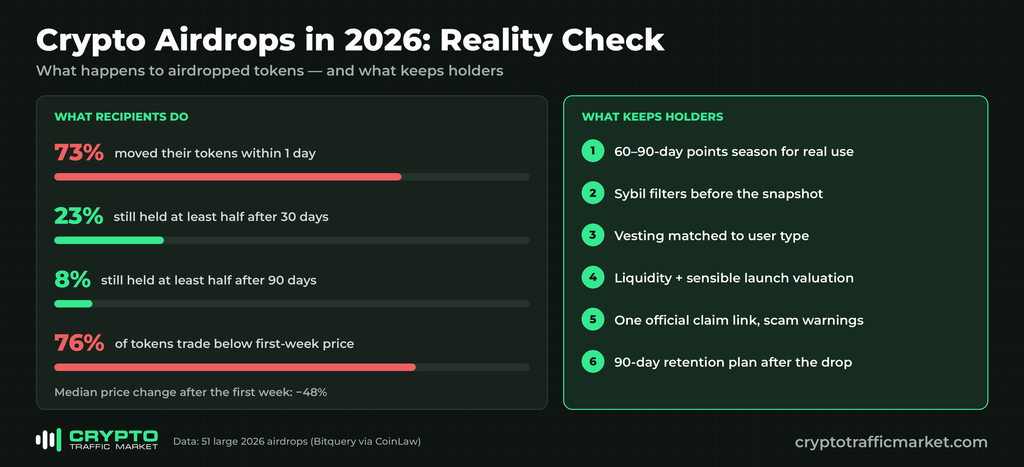
The data on airdrops has been consistent for three years:
- Quick selling. In 51 large 2026 airdrops on Ethereum, BNB Chain, Base, and Arbitrum, 73% of claimers moved their tokens within a day. After 30 days, 23% still held at least half; after three months, 8% (Bitquery data via CoinLaw).
- Price. In the same sample, 35 of 46 tokens traded below their first-week price, with a median drop of 48%.
- Long-term exits. Delphi Digital tracked 3.7 million wallets across six major airdrops and found that 78–94% of recipients sold most of their allocation within 90 days. It estimated that Arbitrum paid about $1.16 billion to users who left within a month (BeInCrypto).
- Earlier data. Keyrock found that 88% of 2024 airdrop tokens fell in price, mostly within the first two weeks (DL News).
Keyrock’s conclusion matters more than the headline: airdrop size isn’t the main problem. A token with 70% of supply airdropped still rose, because its valuation was modest and its distribution was fair. Overvalued launches with thin liquidity are what turn airdrop selling into a crash. Delphi describes the direction of the market in one line: “Token distribution is moving from handouts to performance.”
How to Plan a Crypto Airdrop: 8 Steps
1. Decide what the airdrop is for
Rewarding early users, attracting new ones, decentralizing governance, or creating distribution for a listing — each goal needs different rules. Write down who you want to reach and what they should do after they receive tokens.
2. Define the ideal recipient
Describe the user you want to keep: what they do in the product, how often, with what volume. Turn that description into eligibility criteria and points rules. Real usage over time is harder to fake than a single transaction.
3. Set the allocation and vesting
Many large airdrops have used 5–15% of supply (Uniswap 15%, Arbitrum about 11.6%). More important than the percentage is how it unlocks: active users can get more upfront, while one-time participants get tokens that vest or unlock with continued activity.
4. Run a points season before the snapshot
A 60–90-day points season lets you see who uses the product and builds the community before TGE. Publish the rules, show a leaderboard, and say clearly that points are not a promise of a specific token amount.
5. Filter sybils before the snapshot
Remove wallet farms before you announce eligibility, not after the claim. Details below.
6. Check the legal side
In the EU, MiCA exempts tokens given away for free from the white paper requirement — but an airdrop isn’t “free” if the project collects personal data or receives fees or other value in exchange (analysis of MiCA Art. 4(3)). Task-based airdrops need a legal review in each market. See token sale regulations in 2026.
7. Prepare liquidity and the valuation
Plan DEX liquidity or a market maker before the claim opens, and launch at a valuation the market can absorb. Thin order books are where airdrop selling does the most damage. For the wider pre-TGE checklist, see how to launch a crypto token.
8. Plan the 90 days after the drop
Prepare what recipients get next: product updates, a second season, staking or governance, and community events. An airdrop without a plan for the following weeks pays users to leave.
Sybil Protection: How to Keep Farmers Out
Sybil farms are groups of wallets controlled by one person or bot operator. In the median 2026 airdrop, 11% of claimers sat in linked wallet groups, and in one case 87% of an airdrop went to a single cluster of 11,204 wallets (CoinLaw). Common filters:
- Activity over time: transactions spread across weeks, not all within a few days.
- Minimum depth: more than one contract interaction and a non-trivial balance. Arbitrum, for example, cut points for wallets whose activity all fell within 48 hours, or that held under 0.005 ETH and used at most one contract.
- Funding patterns: wallets funded from the same source, in the same amounts, at the same time.
- Behaviour patterns: identical transaction sequences across many wallets.
- Social checks: account age and real engagement for quest-based tasks.
- Appeals: a short process for real users flagged by mistake.
Publish the general approach to sybil filtering before the snapshot. It discourages farms and shows real users the airdrop is fair.
Marketing Timeline for an Airdrop
| Phase | What to do |
|---|---|
| Before the season | Explain the product and why users should try it; grow X and Telegram; prepare FAQ and rules |
| Points season (60–90 days) | Weekly leaderboard updates, product tutorials, AMAs on X Spaces, KOL content showing the product in use |
| Snapshot and eligibility | Announce the snapshot, explain criteria and sybil filtering, open the eligibility checker on the official site |
| Claim week | Official claim link only from verified channels, pinned scam warnings, live support in Telegram, liquidity in place |
| Days 1–90 after | Next season or staking, product news, community events, holder-only perks; track retention weekly |
Claim security
Every airdrop attracts scammers. In 25 of 51 large 2026 airdrops, fake tokens with matching names appeared in wallets, and wallet drainers took $83.85 million from users in 2025 (CoinLaw). Publish the claim URL in one place, pin it in every channel, tell users you’ll never DM them, and ask moderators to remove fake links fast.
What to say — and what not to say
| Avoid | Use instead |
|---|---|
| “Free money” or “guaranteed rewards” | Clear rules: who qualifies, for what actions, and how tokens unlock |
| Expected token prices or “airdrop worth $X” | Token amounts and vesting, no price talk |
| Vague eligibility that changes later | Published criteria before the snapshot, with an appeals process |
| Claim links in replies or DMs | One official URL, pinned and repeated across official channels |
KPIs: How to Know the Airdrop Worked
| KPI | What it shows |
|---|---|
| Holders at day 30 and day 90 | Share of recipients still holding at least half of their tokens — the main result |
| Active users after the drop | Whether recipients keep using the product |
| Cost per retained holder | Value of tokens distributed divided by holders still active at day 90 |
| Sybil share removed | How much of the allocation was protected from farms |
| Holder concentration | Whether a few wallets control a large share after the claim |
| Community growth quality | Engagement rate on X and Telegram, not just follower count |
Claims, impressions, and followers gained during the campaign are useful, but they say nothing about the result on their own. Budget the airdrop like any other launch channel — see token launch marketing cost.
Airdrops for Meme Coins
Meme coins often use airdrops to holders of other tokens or NFTs, or to active community members. The same rules apply even more strongly: without a product to keep users, everything depends on the community, the narrative, and liquidity. Our meme coin marketing campaigns build that community before and after the drop.
Where an Agency Fits
The design of the airdrop — allocation, vesting, sybil rules — belongs to the team and its tokenomics advisers. What an agency adds is everything around it: bringing real users into the points season, explaining the rules clearly, running KOL and community campaigns, protecting users from scams during the claim, and keeping recipients engaged afterwards. That’s how we support token launches, IDO and presale campaigns, and meme coin promotion.
Crypto Marketing Packages by Project Stage
| Package | Duration | Price | Best for |
|---|---|---|---|
| Trial | 3 days | $175 + $100 in tokens | Pre-sale preparation, ICO/IDO, testing market response |
| Quick Start | 15 days | $1,250 + $600 in tokens | Pre-sale, IDO/IEO, DEX launch — kicking off a points season |
| Standard | 30 days | $3,500 + $1,500 in tokens | Token launch, DEX launch, first CEX listing — the airdrop and claim period |
| Growth | 45 days | $7,500 + $3,500 in tokens | Post-launch growth, new exchange listings — retention and next seasons |
| Pro | 60 days | $12,500 + $8,000 in tokens | Major exchange listings, brand authority, long-term growth |
Planning an airdrop or a points season? Send us your launch date and airdrop plan, and we’ll build the campaign around it.
FAQ
What is crypto airdrop marketing?
Crypto airdrop marketing is planning and promoting a token airdrop so that it brings real users and long-term holders: choosing the format, setting eligibility and points rules, filtering sybils, communicating the claim safely, and keeping recipients engaged after the drop.
Do airdrops still work in 2026?
Yes, but not as simple giveaways. In 2026 data, most claimers sold quickly and only about a quarter held at least half of their tokens after 30 days. Airdrops that reward real usage over time, filter sybils, and plan for the weeks after the drop keep far more holders.
How much of the token supply should go to an airdrop?
Large airdrops have often used 5–15% of supply — Uniswap 15%, Arbitrum about 11.6%. The percentage matters less than vesting, launch valuation, and liquidity; research by Keyrock found a token with 70% airdropped still rose because its valuation and distribution were sensible.
How do you prevent sybil attacks in an airdrop?
Filter before the snapshot: require activity spread over time, more than one meaningful interaction, and a non-trivial balance; detect wallets funded from the same source or behaving identically; check social accounts for quest tasks; and offer an appeals process for real users flagged by mistake.
What is a points program?
A system where users earn points for using a product over weeks or months, with points later converted into tokens. A 60–90-day season shows who the real users are and builds the community before the token generation event.
Is an airdrop legal?
It depends on the market and the design. Under MiCA, tokens given away for free are exempt from the white paper requirement, but an airdrop that collects personal data or gets value in exchange may not count as free. Check task-based airdrops with a lawyer in each target market.
When should you announce an airdrop?
Announce the points season or the eligibility rules early enough for real users to take part — usually 60–90 days before the snapshot — and announce the claim date only when liquidity, the claim page, and security measures are ready.
How do you measure airdrop success?
Track the share of recipients holding at least half of their tokens at day 30 and day 90, active users after the drop, cost per retained holder, sybil share removed, and holder concentration. The number of claims alone doesn’t show success.
Conclusion
Crypto airdrop marketing in 2026 is a retention problem, not a distribution problem. Most recipients sell within days, so the airdrops that work are designed around the users a project wants to keep: a points season that rewards real use, sybil filters before the snapshot, vesting that fits each type of user, enough liquidity, a safe claim, and a plan for the next 90 days. Measure holders and active users, not claims, and the airdrop becomes a growth channel instead of a giveaway.
 Token Sale Rules in 2026: MiCA, SEC, and UK Explained
 Binance Alpha and Binance Wallet TGE: How Projects Get There
 How Much Does It Cost to Market a Token Launch in 2026
 How to Get Listed on a CEX After Your TGE
 Best Crypto Launchpads in 2026: IDO and Public Sale Platforms Compared
 How to Launch a Crypto Token in 2026: Step-by-Step
 Presale Marketing in 2026: What Actually Works
 ICO vs IDO vs IEO vs TGE: Which Token Launch Model Fits Your Project in 2026
 X Ads for Crypto in 2026: What's Allowed and When Organic Works Better