
Quick answer: Token sale regulations in 2026 differ sharply by region. In the EU, MiCA requires a legal-entity offeror and a crypto-asset white paper notified to a regulator 20 working days before publication, unless the offer is below €1 million over 12 months, reaches fewer than 150 people per country, or targets only qualified investors; marketing must match the white paper and can’t start before it’s published. In the US, the SEC said in March 2026 that most crypto assets aren’t securities themselves, and in August 2026 proposed Regulation Crypto Assets with a $5 million startup exemption and a fundraising exemption of up to $75 million a year — still a proposal, so most projects still exclude US buyers or use existing exemptions. In the UK, crypto promotions to consumers must go through an approved route with risk warnings and a 24-hour cooling-off period, and a full licensing regime starts on 25 October 2027.
This article is general information for founders and marketers, not legal advice. Rules change and depend on your token, structure, and audience — confirm your sale with a qualified lawyer in each market you target.
A token sale is now as much a legal project as a marketing one. Launchpads ask for legal opinions, ad platforms restrict token sale promotions, regulators fine influencers, and investors check whether a presale is allowed in their country before they buy. For a project planning a presale, an IDO, or a token launch, the rules decide where you can sell, who you can sell to, and what your marketing can say.
This guide covers token sale regulations in the three markets founders ask about most — the EU, the US, and the UK — and what they mean for your campaign. For the marketing side of a sale, see our ICO and presale marketing page.
Token Sale Rules at a Glance: EU, US, UK
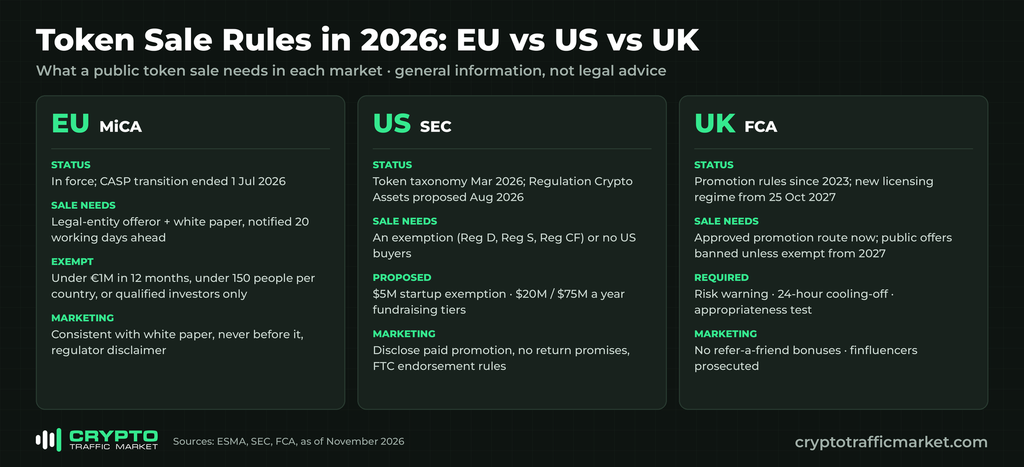
| EU (MiCA) | US (SEC) | UK (FCA) | |
|---|---|---|---|
| Status in late 2026 | Fully in force; transitional period for service providers ended 1 July 2026 | Interpretation issued March 2026; Regulation Crypto Assets proposed August 2026, not final | Promotion rules in force since 2023; full regime starts 25 October 2027 |
| What a public sale needs | Legal-entity offeror and a white paper notified to the regulator, unless exempt | A registration exemption (Reg D, Reg S, Reg CF today; proposed crypto exemptions later) — or no US buyers | An approved route for promotions now; from 2027, public offers are prohibited unless an exception applies |
| Main exemptions | Under €1M in 12 months; fewer than 150 people per country; qualified investors only; free tokens | Proposed: $5M startup exemption over 4 years; $20M or $75M a year fundraising tiers | Promotion exemptions are narrow (e.g. communications to investment professionals) |
| Marketing rules | Clearly marked as marketing, fair, consistent with the white paper, not before the white paper is published | Anti-fraud rules; paid promoters must disclose compensation; FTC endorsement rules | Risk warning, 24-hour cooling-off, no refer-a-friend bonuses, appropriateness test |
EU: MiCA Rules for Token Sales
The Markets in Crypto-Assets Regulation (MiCA) applies to anyone offering crypto-assets to the public in the EU, wherever the project is based. For most tokens (anything other than stablecoins), the key rules sit in Title II.
Who needs a white paper
To make a public offer, the offeror must be a legal person and must draw up, notify, and publish a crypto-asset white paper. The white paper is notified to the national regulator at least 20 working days before publication; regulators don’t pre-approve it (ESMA, MiCA Art. 8).
The white paper isn’t required when (ESMA, MiCA Art. 4):
- the offer reaches fewer than 150 people per EU member state;
- the total raised in the EU stays at or below €1 million over 12 months;
- the offer is addressed only to qualified investors;
- the tokens are given away for free, or are created as rewards for validating the network;
- it’s a utility token giving access to a product that already exists.
Pre-sale tokens for a product that isn’t live yet have an extra limit: the offer can’t run longer than 12 months from publication of the white paper.
Marketing under MiCA
MiCA treats your marketing as part of the offer. Marketing communications must be clearly identifiable as marketing, fair, clear and not misleading, and consistent with the white paper. They can’t be published before the white paper itself, and they must carry the disclaimer that the communication hasn’t been reviewed or approved by any regulator. Regulators can ask to see them, and penalties for breaches can reach €700,000 for individuals and higher amounts for companies (Cerha Hempel). Retail buyers who buy directly from the offeror also get a 14-day right to withdraw.
In practice, that means every channel — X threads, Telegram posts, KOL scripts, banners, press releases — has to say the same thing as the white paper. A KOL promising returns the white paper doesn’t mention is a compliance problem, not just a marketing one.
Exchanges and service providers
The MiCA transitional period for crypto-asset service providers ended on 1 July 2026. ESMA says firms without a MiCA licence must stop serving EU clients, and firms outside the EU can’t solicit EU clients except under a narrow reverse-solicitation exception (ESMA statement). For token projects, this matters when choosing the launchpads and exchanges that will sell or list the token to EU users.
US: SEC Rules for Token Sales in 2026
The US moved from enforcement to rule-making in 2025–2026, but the new framework isn’t finished.
March 2026: the SEC’s token taxonomy
On 17 March 2026, the SEC — joined by the CFTC — issued an interpretation of how securities laws apply to crypto assets, with a taxonomy of digital commodities, digital collectibles, digital tools, stablecoins, and digital securities. Chairman Paul Atkins said “most crypto assets are not themselves securities” and that “investment contracts can come to an end” (SEC). The key point for a token sale: a token may not be a security, but selling it with promises of the team’s future work can still create an investment contract.
August 2026: Regulation Crypto Assets (proposed)
On 18 August 2026, the SEC proposed Regulation Crypto Assets, a set of offering exemptions designed for token sales (White & Case):
| Startup exemption | Fundraising exemption | |
|---|---|---|
| Limit | $5 million over four years, once per token | Tier 1: $20 million per 12 months; Tier 2: $75 million per 12 months |
| SEC review | No review; notice filing (Form NOR) | Offering statement (Form 1-CRYPTO) must be qualified before sales |
| Financial statements | Not required | Tier 1 unaudited, Tier 2 audited |
| Investor limits | None | Non-accredited investors capped at 10% of income or net worth |
Marketing details matter here too. Both exemptions would allow general solicitation, but the startup exemption covers only sales after the notice is filed — earlier promotion could count as an unregistered offer. Sales must be at a fixed price, and paid “ambassadors” or referral programs tied to sales would fall outside the broker safe harbor. Comments closed on 20 October 2026, and final rules aren’t expected before 2027.
Congress and the CLARITY Act
The CLARITY Act, the market structure bill, passed the House 294–134 in July 2025, but on 15 September 2026 the Senate fell short on a cloture vote, 49–50, and the bill has stalled (DeFi Rate tracker). Atkins himself has said legislation remains “indispensable” for durable rules.
What US projects do today
- Exclude US buyers from public sales with geo-blocking, KYC, and terms of sale — still the most common approach for presales and IDOs.
- Use existing exemptions: Regulation D for accredited investors, Regulation S for sales outside the US, or Regulation Crowdfunding.
- Disclose paid promotion. Promoting a security for payment without disclosing it breaks Section 17(b) of the Securities Act, and the FTC requires clear disclosure of paid endorsements for any product.
Meme coins sit in a separate spot: SEC staff said in February 2025 that typical meme coins aren’t securities, but fraud and consumer protection rules still apply. Our meme coin marketing campaigns follow the same disclosure rules as any other token promotion.
UK: FCA Rules for Token Sales
Promotion rules in force today
Since October 2023, promoting crypto to UK consumers is regulated — including for projects based outside the UK. A promotion must be made by an FCA-authorised firm, approved by one, made by an FCA-registered crypto firm, or fit a narrow exemption (Taylor Wessing). Promotions also need:
- the standard risk warning: “Don’t invest unless you’re prepared to lose all the money you invest”;
- a 24-hour cooling-off period for first-time investors with a firm;
- no incentives to invest, such as refer-a-friend or new-joiner bonuses;
- an appropriateness assessment before an order is processed.
Breaking these rules is a criminal offence punishable by up to two years in prison. The FCA enforces them actively: in April 2026 it led a week of action with 17 regulators against illegal “finfluencers,” with a guilty plea from a reality TV personality, 4 warning letters, and 120 account takedown requests (FCA).
The new UK regime from October 2027
The Financial Services and Markets Act 2000 (Cryptoassets) Regulations 2026 create a full licensing regime starting 25 October 2027 (Baker McKenzie):
- public offers of qualifying cryptoassets in the UK are prohibited unless an exception applies;
- tokens admitted to UK trading platforms that serve retail need a qualifying cryptoasset disclosure document (QCDD) (Freshfields);
- overseas firms selling to UK consumers need UK authorisation unless a UK-authorised platform or dealer stands between them and the consumer;
- FCA-registered crypto firms will no longer be able to approve their own promotions;
- the authorisation window runs from 30 September 2026 to 28 February 2027.
Platform Rules on Top of the Law
Even where a sale is legal, the channels you advertise on have their own rules:
- X Ads don’t allow ICO, IEO, or IDO promotion; see our guide to X Ads for crypto.
- Paid crypto partnerships on X are allowed with disclosure since March 2026, but not in the EU, the UK, or Australia (crypto.news).
- Google and Meta require advertiser certification for crypto ads and restrict token sale ads in many countries.
- Launchpads and exchanges usually ask for a legal opinion on the token, KYC on the team, and a list of restricted countries.
How to Run a Compliant Token Sale Campaign: 8 Steps
1. Get a legal opinion first
Before any marketing, have a lawyer classify the token and the sale structure in each target market. Launchpads and exchanges will ask for it anyway.
2. Decide where you sell — and where you don’t
List your restricted countries (commonly the US and other high-risk jurisdictions) and enforce them with KYC, geo-blocking, and terms of sale. Marketing should match: don’t run campaigns targeting countries your sale excludes.
3. Prepare the documents
A MiCA white paper if you sell to EU retail above the thresholds, a clear token page, tokenomics, vesting, and risk disclosures. For the full pre-launch process, see how to launch a crypto token.
4. Write one message and keep it consistent
Every channel should describe the token the same way the white paper does. Build a short messaging guide for the team, moderators, and KOLs.
5. Remove return promises
No “guaranteed 10x,” no price targets, no “risk-free” claims. Describe the product, the utility, the sale terms, and the risks.
6. Disclose every paid promotion
KOLs, ambassadors, and paid articles must be clearly marked as paid. Avoid referral rewards tied to purchases where they’re restricted, as in the UK.
7. Add disclaimers and risk warnings
Regional disclaimers on the website and sale page, the MiCA marketing disclaimer for EU communications, and the FCA risk warning if UK consumers can see a direct promotion.
8. Keep records
Save approved versions of posts, KOL briefs, ads, and landing pages. If a regulator, launchpad, or exchange asks, you can show what was said and when.
What Your Token Sale Marketing Can and Can’t Say
| Avoid | Use instead |
|---|---|
| “Guaranteed 10x after listing” | What the token does, sale price, vesting, and listing plans described as plans |
| “Risk-free early entry” | “Crypto-assets are high-risk; you can lose all the money you invest” |
| Unmarked KOL posts | Clearly labelled paid partnerships with briefs that match the white paper |
| “Listed on Binance soon” without a signed agreement | Confirmed listings only, announced after the exchange announces them |
| Refer-a-friend bonuses for buying | Community campaigns that don’t reward purchases, where incentives are restricted |
| Ads targeting restricted countries | Campaigns aimed only at markets your sale is open to |
Investors read these signals too: clear terms and honest risk language increase trust in a presale. See presale marketing in 2026 for what investors check before they buy.
Where a Marketing Agency Fits
A marketing agency isn’t a law firm, and token sale regulations should be signed off by your lawyers. What an agency does is build a campaign that works inside those rules: choosing channels allowed in each market, writing messaging that matches the white paper, briefing and labelling KOLs, keeping restricted countries out of targeting, and building a community that buys because it understands the project. That’s how we run token launch, presale, IDO, and meme coin promotion campaigns.
Crypto Marketing Packages by Project Stage
| Package | Duration | Price | Best for |
|---|---|---|---|
| Trial | 3 days | $175 + $100 in tokens | Pre-sale preparation, ICO/IDO, testing market response |
| Quick Start | 15 days | $1,250 + $600 in tokens | Pre-sale, IDO/IEO, DEX launch — the token sale stage |
| Standard | 30 days | $3,500 + $1,500 in tokens | Token launch, DEX launch, first CEX listing |
| Growth | 45 days | $7,500 + $3,500 in tokens | Post-launch growth, new exchange listings, private or strategic rounds |
| Pro | 60 days | $12,500 + $8,000 in tokens | Major exchange listings, brand authority, long-term growth |
Planning a presale or IDO? Tell us your sale dates and target markets, and we’ll build a campaign around the countries your sale is open to.
FAQ
Do I need a white paper under MiCA?
Yes, for a public offer of tokens in the EU, unless an exemption applies: an offer to fewer than 150 people per member state, a total of €1 million or less over 12 months, an offer only to qualified investors, free tokens, or a utility token for a product that already exists. The white paper is notified to the regulator 20 working days before publication.
Can I market a presale in the EU before the white paper is published?
No. Under MiCA, marketing communications can’t be published before the white paper, and they must be consistent with it, clearly marked as marketing, and carry the disclaimer that no regulator has approved them.
Is a token sale legal in the US in 2026?
It can be, through a registration exemption such as Regulation D, Regulation S, or Regulation Crowdfunding. The SEC proposed crypto-specific exemptions in August 2026, including a $5 million startup exemption, but they aren’t final yet, so many projects still exclude US buyers from public sales.
What is Regulation Crypto Assets?
An SEC proposal from August 2026 that would create offering exemptions for token sales: a startup exemption of up to $5 million over four years and a fundraising exemption of up to $20 million or $75 million a year, plus a safe harbor for when a token stops being subject to an investment contract.
Can I promote a token sale to UK investors?
Only through an approved route: the promotion must be made or approved by an FCA-authorised firm, made by an FCA-registered crypto firm, or fit an exemption. It must include the standard risk warning, a 24-hour cooling-off period for first-time investors, and no incentives to invest. Breaches are a criminal offence.
When does the new UK crypto regime start?
On 25 October 2027. Public offers of qualifying cryptoassets will be prohibited unless an exception applies, and tokens admitted to UK retail trading platforms will need a qualifying cryptoasset disclosure document.
Do crypto influencers have to disclose paid posts?
Yes. The FTC requires clear disclosure of paid endorsements, US securities law requires paid promoters of securities to disclose compensation, MiCA requires marketing to be clearly identifiable, and X requires a paid partnership label — and doesn’t allow paid crypto partnerships in the EU, the UK, or Australia.
Do meme coins fall under token sale regulations?
Often yes, depending on the market. SEC staff said typical meme coins aren’t securities, but fraud rules still apply. In the EU, a public offer of a meme coin above the MiCA thresholds still needs a white paper, and UK promotion rules apply to meme coins marketed to UK consumers.
Conclusion
Token sale regulations in 2026 come down to three different systems: MiCA in the EU, with clear but strict white paper and marketing rules; a US framework that is being rebuilt but not finished; and a UK regime that already controls promotions and becomes a full licensing system in October 2027. The practical approach is the same everywhere — get legal advice early, decide where you sell, keep every message consistent and honest, and disclose paid promotion. A sale that follows the rules is easier to list, easier to promote, and easier for investors to trust.
 Binance Alpha and Binance Wallet TGE: How Projects Get There
 How Much Does It Cost to Market a Token Launch in 2026
 How to Get Listed on a CEX After Your TGE
 Best Crypto Launchpads in 2026: IDO and Public Sale Platforms Compared
 How to Launch a Crypto Token in 2026: Step-by-Step
 Presale Marketing in 2026: What Actually Works
 ICO vs IDO vs IEO vs TGE: Which Token Launch Model Fits Your Project in 2026
 X Ads for Crypto in 2026: What's Allowed and When Organic Works Better
 Best Crypto Twitter Marketing Agencies in 2026


