

If you have ever tried launching advertising for a Web3 or crypto project through standard platforms like Google Ads or Meta Ads, you have likely encountered a typical scenario: keyword restrictions, unexpected ad rejections, and a general shadowban on anything resembling crypto. This is exactly why the industry developed crypto ad networks—specialized networks that connect advertisers with crypto media, websites, and audiences.
This article provides a practical guide: the differences between native and banner/display ads, the available networks, the problems they solve, the metrics to watch, and how to build a working strategy.
What is a Crypto Ad Network and What Problems Does It Solve?
A crypto ad network acts as an intermediary platform between a Web3 advertiser and publishers who possess a crypto-focused audience (media outlets, websites, and occasionally apps). These networks typically provide:
- Access to placements on specific crypto platforms.
- Specialized ad formats (banners, native blocks, sponsored content/PR).
- Dashboards with analytics and targeting settings (geo, devices, language, etc.).
The primary value for the advertiser is the ability to launch a campaign on their own terms in an environment where crypto formats and creatives are accepted, unlike in general advertising networks.
Tools: Banner (Display) and Native Advertising
Banner / Display Advertising
These are visual placements (images, HTML5, animation) located in advertising slots on a website. The goal is often reach and repeated exposure (brand awareness), and sometimes direct clicks. Crypto networks usually sell “display ads” or “banner ads” as one of their base formats.
When to use:
- When you need to quickly build awareness before a launch.
- When mass impressions and repeated touchpoints are important.
- When you have a strong visual message (listing, release, major news).
What is Native Advertising?
Native advertising is an ad format that blends into the website’s content to look like an organic part of the page. These ads typically appear as links resembling standard articles, news, or recommendations rather than a distinct advertising banner. This helps users perceive them as less intrusive and increases the likelihood of a click.
How it looks in crypto:
- It may appear as a block labeled “Related Articles,” “Recommended for You,” or “Sponsored Content” with a headline and brief description.
- It is frequently used on thematic crypto news sites.
- It is not just an image or banner, but an ad that mimics the visual style of the platform and looks like part of the editorial flow.
When to use:
- When it is important not just to show a logo, but to convey meaning (what the project is, why it matters).
- When the focus is on high-quality traffic and genuine interest rather than just reach.
Key Metrics
To measure success, you must understand the following metrics:
CPM (Cost Per Mille)
This is the price for 1,000 ad impressions.
- Formula: CPM = Cost / (Impressions / 1000)
CTR (Click-Through Rate)
This is the percentage of people who clicked after seeing the ad.
- Formula: CTR = (Clicks / Impressions) * 100%
CPC (Cost Per Click)
The cost you pay each time a user clicks on the ad.
- Formula: CPC = Cost / Clicks
Most Relevant Crypto Ad Networks in 2026
According to Crypto Traffic Market, these are the top platforms to consider:
1. AdsNetwork
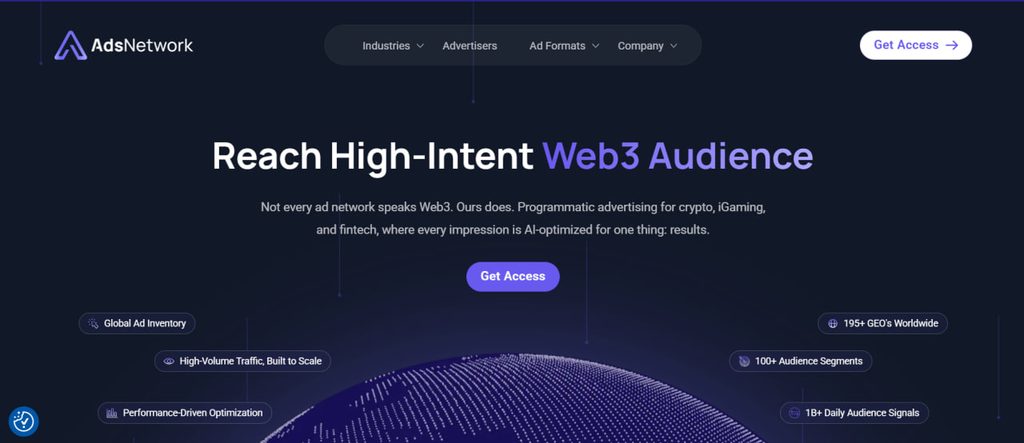
Overview: AdsNetwork is a programmatic advertising platform for crypto, Web3, iGaming, and fintech businesses, combining AI-powered campaign optimization with access to 2,500+ publishers. It offers seven ad formats, including display banners, native ads, video pre-roll, HTML5, mobile interstitials, pop-unders, and in-page push, with targeting across 195+ GEOs and 100+ audience segments, including on-chain audience targeting.
Pros:
- AI-powered optimization for bids, audiences, and creatives, with automated campaign management.
- Advanced Web3 audience targeting using behavioral signals, interests, and on-chain data.
- Real-time reporting for impressions, clicks, conversions, and return on ad spend (ROAS).
- Multiple ad formats and global publisher inventory to support campaigns from brand awareness to user acquisition.

2. Blockchain-Ads
Overview:
A leading crypto ad network connecting advertisers with over 1 billion blockchain-native and mainstream audiences across display, banners, and 8+ additional formats, with granular targeting spanning 195 GEOs and individual wallets.
Pros:
Built-in traffic quality with proprietary bot filtering and direct DoubleVerify integration.
Real-time analytics and wallet-level attribution out of the box.
Seamless compatibility with third-party tools (Voluum, AppsFlyer, Keitaro).
Flexible CPM and CPC pricing models for aggressive scaling.

3. Coinzilla
Overview: One of the most well-known advertising networks working with banners and native ads on financial and crypto websites.
Pros:
- Large reach across popular websites.
- Flexible formats (banners, native, content distribution).
- Support for analytics and targeting.
- Best for: Brands where broad presence on profile sites is important. A good option if you need native placement with an accessible budget entry point.

4. AADS
Overview: A network marketplace for banners, publications, and PR materials worldwide with a focus on crypto audiences.
Pros:
- Ability to pay in cryptocurrency.
- Low CPM (approx. $0.03), which can be profitable for large volumes.
- Various formats: banners, articles, native.
- Best for: Projects prioritizing low costs per impression rather than just clicks.

5. Slise
Overview: A relatively new Web3-oriented platform where ad campaigns are launched with automatic optimization and targeting.
Pros:
- Offers native and display formats.
- Minimum budget starting from approx. $100.
- Focus on DeFi/Web3 audiences.
- Best for: Projects wanting Web3-oriented campaigns with automation.

6. Decentralized Networks (Brave Ads / AdEx)
Brave Ads: Advertising via the Brave browser; users receive BAT tokens for viewing.
AdEx Network: A decentralized advertising network on the blockchain.
Pros:
- Very low commissions.
- More private targeting.
- Suitable for projects targeting a privacy-first audience.
- Best for: Those ready to experiment with less traditional formats and channels.
Strategy: When to Use What
Pre-Launch Phase
- Strategy: Native ads + Soft banners.
- Goal: preparation of trust and initial touchpoints.
Launch Phase (IDO/IEO/Listing/Presale)
- Strategy: Strengthened banners + Native support.
- Goal: Maximum visibility via banners, while native ads support the “meaning” and value proposition.
Post-Launch / Growth Phase
- Strategy: Banners for retention, Native ads/content for reputation.
- Goal: Maintaining presence and converting users into long-term interest.
Conclusion
Native and banner advertising are not the same; they are two distinct mechanics that work best in tandem. Native ads create context and trust, while banners add frequency and brand recognition. Crypto ad networks simplify the launch of these campaigns in the Web3 niche, but the result depends on the correct media mix, the project phase, and the quality of the traffic.
Comparison of Ad Formats
| Feature | Banner (Display) Ads | Native Ads |
| Primary Goal | Awareness, Visibility, Recall | Trust, Education, Engagement |
| Visual Style | Stands out (Graphics, Animation) | Blends in (Matches site content) |
| User Experience | Can be intrusive, ignored (banner blindness) | Less intrusive, higher reading intent |
| Best For | Listings, Big News, Retargeting | Explaining complex DeFi/Web3 concepts |
| Key Metric | Impressions (CPM) | Engagement/Clicks (CTR) |
Frequently Asked Questions (FAQ)
1. Why can’t I just use Google Ads for my crypto project?
While some restrictions have loosened, Google and Meta still have strict policies regarding financial products and cryptocurrencies. You face a high risk of ad rejection, account bans, or limited reach. Crypto ad networks are specifically designed to accept these products.
2. What is the minimum budget required to start?
This varies by network. Some platforms like AADS or Slise allow you to start with as little as $50-$100. However, for a noticeable impact on a larger network like Coinzilla or Cointraffic, a daily budget of $50-$200 is recommended.
3. Can I pay for advertising using cryptocurrency?
Yes, this is a standard feature of crypto ad networks. Most platforms accept payments in USDT, USDC, BTC, or ETH, and some decentralized networks allow payments in their native tokens.
4. Which is better for a token sale: Native or Banner ads?
For a token sale (IDO/Presale), you generally need a mix. Use banners to create urgency and massive visibility (“Sale ends in 24h”) and native ads to explain the utility of the token so investors understand what they are buying.
5. How do I know if the traffic is real?
Bot traffic is a risk in any advertising. Look for networks that offer transparent analytics. Monitor your conversion rate on your landing page—if you get thousands of clicks but zero wallet connections or time-on-site is under 1 second, the traffic quality may be low.
 Token Sale Rules in 2026: MiCA, SEC, and UK Explained
 Binance Alpha and Binance Wallet TGE: How Projects Get There
 How Much Does It Cost to Market a Token Launch in 2026
 How to Get Listed on a CEX After Your TGE
 Best Crypto Launchpads in 2026: IDO and Public Sale Platforms Compared
 How to Launch a Crypto Token in 2026: Step-by-Step
 Presale Marketing in 2026: What Actually Works
 ICO vs IDO vs IEO vs TGE: Which Token Launch Model Fits Your Project in 2026
 X Ads for Crypto in 2026: What's Allowed and When Organic Works Better
 Best Crypto Twitter Marketing Agencies in 2026


