
Quick answer: To choose crypto Twitter influencers, judge KOLs by their audience, not their follower count. Before paying, check the newest 100 followers for bots, compare views with followers on the last 20 posts, see which known crypto accounts follow them, look at what happened to tokens they promoted before, check their wallets for selling around their own posts, and confirm they label paid posts with “#ad”. Several niche micro KOLs usually outperform one expensive macro account. For a token launch, IDO, or meme coin, pay part upfront and part after delivery, avoid unlocked token allocations, and track results by clicks, wallets, and community joins.
KOLs are the fastest way to put a crypto project in front of an audience that already trusts someone. They’re also the easiest place to waste a launch budget. Follower counts are inflated, paid posts are often hidden, and some influencers trade against the very followers they’re sending to your token.
This guide explains how to choose crypto Twitter influencers who actually move results: what KOLs cost, a 9-point vetting checklist, the red flags of fake influencers, how to structure a deal, and which KOLs fit each stage — from pre-sale and IDO to token launch, meme coin promotion, and exchange listings.
Crypto KOL Tiers and Prices in 2026
| Tier | Followers | Typical price on X | Best use |
|---|---|---|---|
| Nano | 5K–25K | $100–$500 per post | Niche reach, testing messages, meme coin waves |
| Micro | 25K–100K | $1,000–$2,000 per post | The best price-to-engagement for most projects |
| Mid-tier | 100K–500K | $3,000–$8,000 per post | Launch moments, broader awareness |
| Macro | 500K–1M | $10,000–$50,000 per campaign | Large launches and listings |
| Tier 1 | 1M+ | $80,000–$200,000+, often with token allocation | Major brands and top-tier launches |
Rates from Disence’s Web3 KOL budget guide. For the full budget picture, see our breakdown of crypto Twitter marketing cost.
Why Choosing KOLs Is Harder in 2026
- Hidden paid posts. In September 2025, on-chain investigator ZachXBT published a leaked price sheet of more than 200 crypto influencers paid by a single project, with rates from $50 to $60,000 per post. Of the 160+ accounts that accepted the deal, he saw fewer than five disclose it as an ad (Cybernews).
- Front-running. In October 2026, Bubblemaps reported that a KOL with about 200,000 followers used five linked wallets to buy tokens about 20 seconds before recommending them, then sell into the buying from followers — around $130,000 in profit, with 61% of 534 recommendations front-run (TechFlow).
- Bot audiences. Follower counts can be bought, and engagement can be farmed. A large account with no real audience is a common way to lose a KOL budget — see how to tell real from bot followers.
- Stricter rules. X requires paid partnership posts to carry a visible label such as “Ad” or “#ad” (KuCoin News), and in January 2026 it banned InfoFi apps that paid users to post. Many projects have moved from “post-to-earn” programs back to direct KOL deals — which makes vetting each KOL more important.
How to Vet a Crypto KOL: 9-Point Checklist
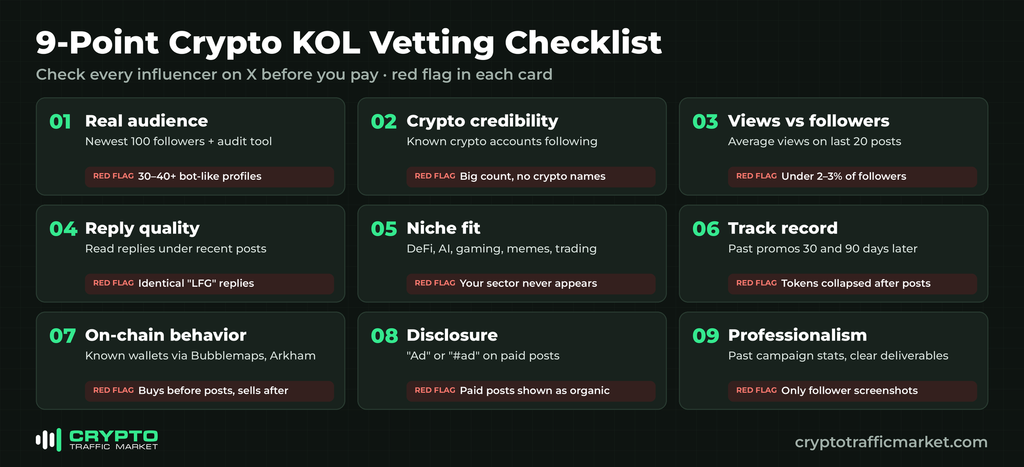
| # | Check | How to do it | Red flag |
|---|---|---|---|
| 1 | Real audience | Open the newest 100 followers; run an audit tool | More than 30–40 empty or bot-like profiles |
| 2 | Crypto credibility | Check which known crypto accounts follow them, for example with a Sorsa (TweetScout) score | 200K followers, almost no known crypto accounts |
| 3 | Views vs followers | Average views on the last 20 posts | Consistently under 2–3% of followers |
| 4 | Reply quality | Read replies under recent posts | Identical “LFG 🚀” replies within the same minute |
| 5 | Niche fit | What they post about most: DeFi, AI, gaming, memes, trading | Your sector never appears in their feed |
| 6 | Track record | Find past promotions and check those tokens 30 and 90 days later | A trail of tokens that collapsed after their posts |
| 7 | On-chain behavior | Check known wallets with tools like Bubblemaps or Arkham | Buying just before posts, selling soon after |
| 8 | Disclosure | Look for “Ad” or “#ad” on past paid posts | Paid posts presented as organic opinion |
| 9 | Professionalism | Ask for stats from a past campaign and a clear list of deliverables | Only screenshots of followers; refuses to share results |
None of these checks takes long. Together they filter out most fake influencers before any money moves.
Red Flags of Fake Crypto Influencers
- Follower count far ahead of engagement — 100K followers and 20 likes per post.
- Sudden follower jumps with no viral post or event behind them.
- Dozens of promotions a week for unrelated tokens.
- “Guaranteed pump” or price promises. No honest KOL can promise price action, and promising it is a liability for your project.
- Payment only upfront, in full, with no reporting afterwards.
- Demands for large unlocked token allocations — an invitation to sell on launch day.
- Asks you not to disclose the deal so it “looks organic.”
- A management “agency” with a price list of hundreds of accounts and no audience data for any of them.
How to Structure a KOL Deal
- Write a brief, not a script. Key facts, links, dates, and what not to say (no price predictions, no “guaranteed returns”). Let the KOL write in their own voice — their audience can tell.
- Define deliverables. Number of posts, threads, quote posts, Spaces appearances, and timing.
- Split payment. Part upfront, the rest after delivery and stats. For larger deals, tie part of the fee to agreed metrics such as clicks or sign-ups.
- Be careful with tokens. If you pay in tokens, use vesting rather than unlocked allocations, so the KOL’s incentives stay aligned after launch.
- Require disclosure. Every paid post labeled “Ad” or “#ad”.
- Track everything. Unique UTM links or referral codes per KOL, so you can compare cost per result.
Which KOLs Fit Each Project Stage
| Stage | KOL mix | Goal |
|---|---|---|
| Pre-sale, ICO, IDO preparation | 3–10 niche nano and micro KOLs; educational threads | Awareness, allowlist sign-ups, testing messages |
| Token launch, DEX launch | Micro KOLs in a timed wave plus one or two mid-tier posts; Spaces appearances | Traffic and buyers in launch week |
| Meme coin promotion | Many meme-native nano and micro KOLs; memes and quote posts | Viral spread and holder growth |
| First CEX listing, new exchange listings | Mid-tier and macro KOLs; trading-focused accounts | Volume and credibility around the listing |
| Post-launch growth | Recurring micro KOLs; long-term ambassadors | Retention and steady new holders |
Timing matters as much as selection. Spread KOL posts through the pre-launch calendar rather than putting all of them in one day — see our 30-day X plan before a token launch.
Micro vs macro: where the budget goes further
| $10,000 budget | What you get | Trade-off |
|---|---|---|
| One mid-tier KOL campaign | 2 posts to a large audience | One audience, one moment; no way to compare what works |
| Five micro KOLs | 1 post each, $2,000 per KOL | Five niche audiences; results you can compare |
| Mixed: three micro + ten nano | 13 posts across several niches | Broad, repeated visibility; more coordination |
For most projects, the mixed approach wins: test with smaller KOLs, then scale the ones whose audiences actually convert.
How to Measure KOL Results
| Metric | How to track |
|---|---|
| Clicks and cost per click | Unique UTM link per KOL |
| Cost per wallet or sign-up | Referral codes or on-chain attribution; Disence suggests around $50–$150 per wallet as a healthy benchmark |
| Telegram and community joins | Separate invite links per KOL |
| New followers on your account | Follower change in the 48 hours after the post |
| Engagement on the KOL’s post | Replies and quotes, not just likes |
| Holders after 30 days | Did buyers stay or sell immediately? |
Rules to Know Before Paying Crypto Influencers
- X: paid partnership posts must carry a visible label such as “Ad” or “#ad”; undisclosed promotions risk warnings and suspension.
- United States: the FTC requires clear disclosure when an endorser is paid or receives free tokens, and the SEC has fined promoters who didn’t disclose payment for tokens treated as securities.
- European Union: under MiCA, crypto marketing must be clearly identifiable as marketing, fair, clear, and not misleading, and consistent with the white paper; the final MiCA transition period ended on 1 July 2026 (Coinranking).
- United Kingdom: crypto promotions must be made or approved by an authorised or registered firm and carry the FCA’s risk warning; a new full crypto regime is set to start in October 2027.
This is a general overview, not legal advice. If your token sale targets specific countries, check the rules there before the campaign starts.
Working with an Agency vs Booking KOLs Yourself
Booking KOLs directly can work if you have time to vet every account, negotiate, and track results. Most teams don’t in the weeks before a launch. An agency brings an already vetted network, negotiated rates, and campaign data from previous launches.
Our crypto influencer marketing service works mainly with KOLs up to around 100K followers, where price-to-engagement is strongest, and books mid-tier and tier-1 accounts when a launch needs them. Every KOL is checked for audience quality, niche fit, and disclosure before a campaign, and every post is tracked with its own link. KOL campaigns pair well with X (Twitter) promotion, so the traffic KOLs send lands on an account worth following.
Crypto Marketing Packages by Project Stage
KOLs work best as part of a plan. Our packages combine X growth from real crypto-native audiences with Telegram, community, trackers, PR, and KOL campaigns, matched to the stage of your project:
| Package | Duration | Best for |
|---|---|---|
| Trial | 3 days | Pre-sale preparation, ICO/IDO, testing market response |
| Quick Start | 15 days | Pre-sale, IDO/IEO, DEX launch |
| Standard | 30 days | Token launch, DEX launch, first CEX listing |
| Growth | 45 days | Post-launch growth, new exchange listings, private or strategic round |
| Pro | 60 days | Major exchange listings, brand authority, long-term growth |
Planning a KOL campaign for a launch? Send us your project details and we’ll suggest a KOL mix and budget.
FAQ
How do you choose crypto Twitter influencers?
Choose by audience quality and niche fit, not follower count. Check the KOL’s newest followers for bots, compare views with followers, see which known crypto accounts follow them, review what happened to tokens they promoted before, check their wallets for trading around their posts, and confirm they disclose paid posts.
How can you spot a fake crypto influencer?
Common signs are high follower counts with very low views and engagement, sudden follower jumps, generic bot replies, dozens of unrelated promotions a week, price or “pump” promises, refusal to share past campaign stats, and requests to keep the paid deal undisclosed.
How much do crypto Twitter influencers charge?
Typical 2026 rates are $100–$500 per post for nano KOLs (5K–25K followers), $1,000–$2,000 for micro KOLs (25K–100K), and $3,000–$8,000 for mid-tier accounts (100K–500K). Macro and tier-1 KOLs charge from $10,000 to $200,000+ per campaign, often including token allocation.
Are micro or macro KOLs better for a token launch?
For most projects, several niche micro KOLs deliver more engaged traffic per dollar than one macro post, and they let you compare which audiences convert. Mid-tier and macro KOLs make sense for launch day and exchange listings once you know which messages work.
Should you pay crypto KOLs in tokens?
Only with vesting. Unlocked token allocations give KOLs an incentive to sell at launch, often into the buying from their own followers. Many projects pay in stablecoins, or split payment between stablecoins and vested tokens.
Do crypto influencers have to disclose paid posts?
Yes. X requires paid partnership posts to carry a visible label such as “Ad” or “#ad”, and rules such as the FTC’s endorsement guidance in the US and MiCA in the EU also require paid crypto marketing to be identifiable as such.
How do you measure the ROI of a KOL campaign?
Give each KOL a unique tracking link or referral code, then compare cost per click, cost per wallet or sign-up, Telegram joins, new followers, and how many buyers still hold after 30 days. A cost of around $50–$150 per wallet is often used as a healthy benchmark.
Can KOL promotion get a project’s X account limited?
Disclosed KOL posts are allowed. Problems come from undisclosed paid promotions, coordinated reply raids organized by KOL groups, and paid engagement schemes, which X treats as manipulation. See our X shadowban guide for details.
Conclusion
The right crypto Twitter influencers can fill a pre-sale, carry a token launch, or start a meme coin wave. The wrong ones bring bot audiences, hidden promotions, and holders who were front-run before they bought. Vet every KOL with the nine checks above, favor several niche micro KOLs over one big name, structure deals so incentives stay aligned, and measure results by wallets and community, not impressions. That’s how a KOL budget turns into a launch rather than a lesson.
 Twitter Spaces for Crypto Projects: How to Host AMAs and Build a Community in 2026
 Crypto Twitter Engagement Strategy: Replies, Comments, and Threads That Work
 Real vs Bot Followers: How to Check a Crypto X Audience
 Is X Premium or Verified Organizations Worth It for Crypto Projects in 2026?
 X Shadowban for Crypto Projects: How to Check and Fix It in 2026
 How to Warm Up a New X (Twitter) Account for a Crypto Project in 2026
 Crypto Twitter Before a Token Launch: A 30-Day X Plan for 2026
 Top 5 Crypto Marketing Agencies in the UK in 2026
 Buying Aged X Accounts for Crypto: Risks and Safer Alternatives in 2026


